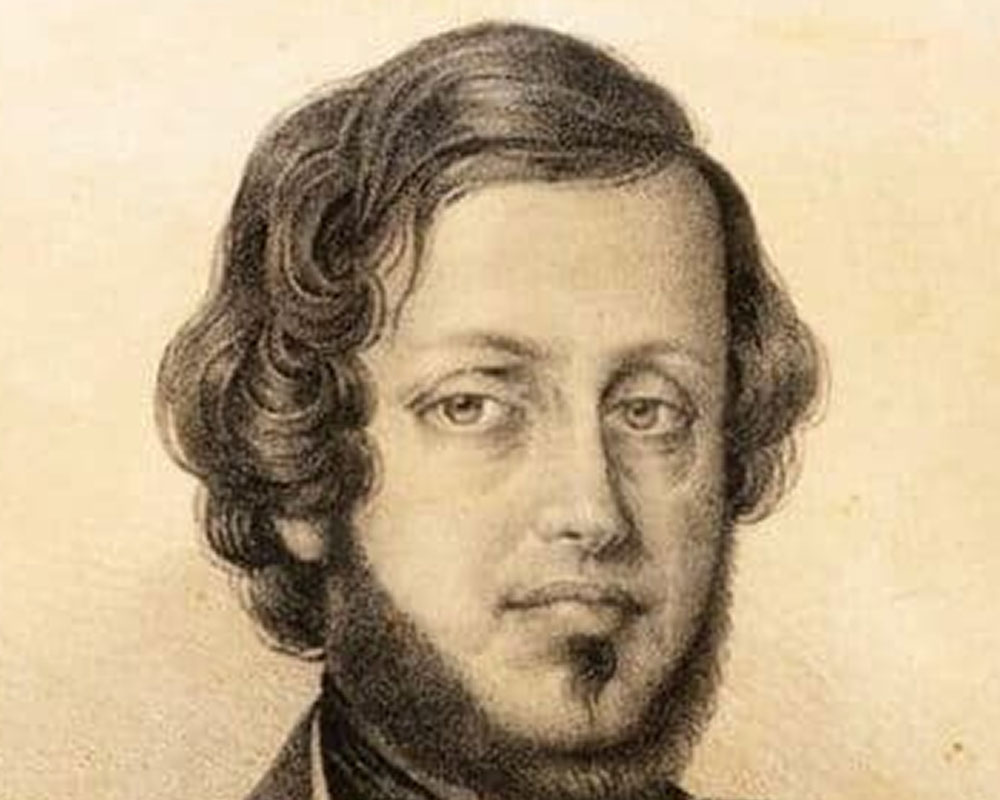
Porto, Childhood, and the Roots of Imagination
Born in the city of Porto on February 4, 1799, in the bosom of a bourgeois family, the boy who would become the Viscount of Almeida Garrett initially received only the name João Leitão da Silva. The patronymics that would immortalize him – Baptista (in honor of his godfather), Almeida (from his maternal grandmother), and Garrett (from his paternal grandmother, of Irish origin) – would be added later.
His childhood unfolded until the age of ten between two family properties in Vila Nova de Gaia: the Quinta do Castelo and the Quinta do Sardão. In these rural spaces, young João heard popular songs and compositions from oral tradition, told and sung by two maids who would indelibly mark his imagination: old Brígida, whom he would remember for her "histórias da carochinha" in Travels in My Land, and the mulatta Rosa de Lima, evoked in the preface to "Adozinda" as a reciter "de maravilhas e encantamentos, de lindas princesas, de galantes e esforçados cavaleiros".
From these childhood memories would spring the taste for national traditions that would lead him from a very young age to compile texts later used in the edition of the Romanceiro and the Cancioneiro, and included in some of his theatrical plays.
The Azorean Refuge and Classical Formation
His father, António Bernardo da Silva, a senior customs official born on the island of Faial, decided in 1809 that the family should seek refuge on Terceira Island before General Soult's Napoleonic troops took Porto during the second French invasion. In the Azores, João Baptista received a classical and enlightenment education – with readings of Voltaire and Rousseau that taught him the value of Liberty – guided by two notable uncles: João Carlos Leitão and, especially, the poet and humanist D. Frei Alexandre da Sagrada Família, who had been Bishop of Malacca and Angra, and bishop-elect of Congo and Angola.
He studied Latin and Greek, classical literature and philosophy under the influence of his uncles and his parents' wishes. The young man even considered embracing an ecclesiastical career, an idea he quickly abandoned for not feeling called to the priesthood. On the islands he began to write under the pseudonym Josino Duriense, still influenced by the classical style that then dominated.
Coimbra: The Liberal and Masonic Awakening
Returning to the mainland, he enrolled in 1817 in the Law course at the University of Coimbra, a focus of fermentation of liberal ideas. In the city of Mondego he founded a masonic society with Manuel da Silva Passos and José Maria Grande, established an academic theater, and had the drama Xerxes (which was lost) and the tragedy Lucrécia performed. In the same period he attempted to write two other tragedies, Afonso de Albuquerque and Sofonisba, which he left incomplete. A finalist in 1820, he received with enthusiasm and optimism the news of the liberal revolution then erupting. Upon completing his Law degree, he departed for Lisbon where he actively participated in the constitutional movement.
First Loves, First Persecutions
In 1821, during the performance of the tragedy Catão, he met the woman who would become his wife: Luísa Midosi, cousin of his friends Luís Francisco and Paulo Midosi. That same year he published the poem "Retrato de Vénus" and was accused in the pages of the Gazeta Universal by Father José Agostinho de Macedo of being "materialista, ateu e imoral". In Coimbra he was suspected of abuse of press freedom for the responses he gave in his defense in the periodical Português Constitucional Regenerado, an accusation from which he was cleared in early 1822.
This year 1822 proved extraordinarily fruitful. He founded with his friend Luís Francisco Midosi a newspaper dedicated to Portuguese ladies: O Toucador: periódico sem política, which despite its subtitle contained numerous more or less subtle references to national events. He was also appointed official of the Ministry of the Kingdom and married Luísa Midosi. The contents of the publication were not unrelated to the sessions of the Sociedade Literária Patriótica, then created, of which prominent figures of the Constitutional Party were members.
The First Exile: England and France (1823-1826)
In 1823, following the Miguelist uprising known as Vila-Francada and the restoration of absolutism, he was forced to abandon his position at the Secretariat of Kingdom Affairs. Imprisoned in the Limoeiro Prison in Lisbon, he departed shortly thereafter for political exile: first England, in the city of Birmingham, then France, in Le Havre.
Garrett and his family lived with great difficulties, the poet obtaining only employment in a bank as a commercial correspondent. He then came into contact with romantic literature – Byron, Lamartine, Victor Hugo, Schlegel, Walter Scott, Madame de Staël –, rediscovered Shakespeare and, influenced by collections of popular songbooks, began to prepare the Romanceiro.
Meanwhile he wrote and published in Paris the poems Camões (1825) and D. Branca (1826), the first Portuguese works of romantic character, fruit of the aesthetic metamorphosis operated by the new readings during the English exile. In 1826 he also published the Bosquejo da História da Poesia e Língua Portuguesa, as an introduction to the anthology Parnaso Lusitano.
The Ephemeral Return and the Second Exile (1826-1832)
With the death of D. João VI in 1826, the writer was amnestied. He returned only after the Granting of the Constitutional Charter and the abdication of D. Pedro IV in favor of his daughter D. Maria da Glória, showing confidence in the Charter, more moderate than the Vintista program. In Lisbon he founded with Paulo Midosi the newspaper O Português and wrote for O Cronista, dedicating himself to political journalism.
The poet and the two Midosi brothers were arrested in 1827 due to articles defending liberalism. In 1828, with D. Miguel's return to Portugal and the resumption of absolute power, Garrett found himself obliged to depart for a second English exile. This time, having as employment the position of private secretary to the Duke of Palmela, also exiled, he settled in Plymouth.
In London he published Adozinda and Bernal Francês (later inserted in the Romanceiro) and the Lírica de João Mínimo (1829), which gathered poems written since his youth, still of arcadian tonality. In the same year, again with Paulo Midosi, he edited the newspaper O Chaveco Liberal and began writing Da Educação, a treatise aimed at the instruction of the young queen D. Maria II for the position she occupied. His political concerns led him to gather in the volume Portugal na Balança da Europa (London, 1830) the articles published in O Português, where he analyzed the history of the Portuguese crisis and exhorted unity and moderation. His journalistic path continued in 1831, in the pages of O Precursor. He prepared in Paris, with other exiles, the expedition that, departing from the Azores, aimed at the end of Miguelism.
The Liberal War and the Siege of Porto (1832-1834)
In 1832, he joined with Alexandre Herculano the academic corps of volunteers that constituted the liberal opposition on Terceira Island. He was one of the expeditionaries who in July of that year disembarked at Mindelo and liberated Porto. During the siege, he began writing the novel O Arco de Sant'Ana which, according to him, was based on an old manuscript found in the Convento dos Grilos, where the expeditionaries were quartered.
The novel describes a popular uprising against the Bishop of Porto – lord of the city – aided by D. Pedro I and led by a young student placed at the head of the bourgeois population confronting the overlord. It is almost impossible not to establish a parallel between the medieval narrative and the coeval events of the writing, with D. Pedro IV at the head of the battalion of students from the bourgeoisie, fighting against absolutist arrogance. The first volume was only published in 1845 and the second only in 1850, the author tracing, in the first chapter of the late volume, the reasons that delayed the edition, to which the revolt of Maria da Fonte and the Patuleia civil war of 1846 were certainly not unrelated.
He also collaborated with Mouzinho da Silveira on administrative reforms that revolutionized the structure of the Portuguese State.
The Belgian Consulate: Third Voluntary Exile (1834-1836)
In 1834, in a kind of third exile motivated by growing disenchantment with Portuguese politics – the division of liberals, the race for public office –, he was appointed Consul-General and Chargé d'Affaires of Portugal in Belgium. In that country he came into contact with German language and literature (Herder, Schiller, and Goethe), which greatly influenced his literary style and conception of art. He also exercised diplomatic functions in London and Paris during this period.
The September Revolution and the Refounding of the National Theater (1836-1841)
Returning to Portugal in 1836, he separated from Luísa Midosi and began living with Adelaide Pastor Deville, with whom he had a daughter. He founded the newspaper O Português Constitucional. After the September Revolution, he was elected deputy to the constituent courts, became a member of the Administrative Code reform commission, and was appointed by Passos Manuel as President of the Conservatory of Dramatic Art and Inspector-General of Theaters.
That same year he addressed to Queen D. Maria II his project for the creation of a National Theater, intervening in the project for the future Teatro Nacional de D. Maria II. The program for the renewal of Art in Portugal is described in the preface to Um Auto de Gil Vicente (1838), the first of his contributions to the repertoire of plays with deep national roots that he considered essential to create in the Portuguese people a love for theater. This play would be followed by Filipa de Vilhena (performed in 1840, the same year he was appointed Chief Chronicler of the Kingdom), O Alfageme de Santarém (1842), and Frei Luís de Sousa (1843).
Life was divided between writing and politics, but it was the latter that caused him the greatest displeasures: minister António José de Ávila proposed in 1841 the dissolution of the Conservatory; deputy Almeida Garrett responded to him directly – the next day he was dismissed from all his positions.
The Most Intense Creative Period (1843-1850)
In 1843, the Revista Universal Lisbonense published in installments the first part of the novel Travels in My Land, inspired by a trip to Ribatejo visiting Passos Manuel, then in opposition to Costa Cabral's government. The work, whose volume edition was only completed in 1846, is considered by critics as the beginning of modern prose in Portugal – an "inclassificável" book that mixes essay, chronicle, novel, and philosophical digression.
The first performance of Frei Luís de Sousa, with Garrett in the role of Telmo, also took place in 1843, at the Teatro da Quinta do Pinheiro. The tragedy was published the following year, three years after the death of Adelaide Deville (1841), an episode that would inspire the work. It was when he met Rosa Montufar Barreiros, Viscountess of Light, with whom he fell deeply in love. To her he addressed letters of exacerbated desire and she inspired him the volume Folhas Caídas.
In the year 1843 he also published the first volume of the Romanceiro, a collection of poetry from popular tradition. In 1845, he launched the book of lyrical poetry Flores sem Fruto and the first volume of O Arco de Sant'Ana.
In the years of Cabralism and following, distanced from politics, he frequented elegant society and wrote the plays Tio Simplício, Falar Verdade a Mentir, and Um Noivado no Dafundo. In 1848 A Sobrinha do Marquês was performed at the Teatro de D. Maria II, published immediately after.
The Regeneration and the Final Years (1851-1854)
With Alexandre Herculano, Rodrigues Sampaio, Rebelo da Silva, and José Estevão, he was appointed in May 1851 to draft a new electoral law project. After a period of distancing from political life, he returned with the Regeneration, a movement that promised conciliation and progress. That year he founded the newspaper A Regeneração, accepted the title of Viscount of Almeida Garrett, and reassumed the role of deputy, collaborating on the proposed revision of the Constitutional Charter.
In June he was appointed plenipotentiary minister for negotiations with the Holy See. The French government granted him the diploma of Grand Officer of the Legion of Honor. The dream of seeing his ethnographic collection work published was finally realized with the publication of volumes II and III of the Romanceiro. Re-elected deputy in 1852, he wrote and read in the Chamber the "Discurso de Resposta ao Discurso da Coroa", having been shortly thereafter appointed Peer of the Kingdom. He became, for a brief period, Minister of Foreign Affairs, a position from which he resigned shortly after. He published various Studies.
The following year he returned to the administration of the National Theater, but resigned at the request of actors and authors. In 1853 he published two editions of Folhas Caídas (the second with the title Fábulas: Folhas Caídas), a book of lyrical poetry received with some scandal: the poet was then a respectable public figure (deputy, minister, viscount) who dared to sing of love defying all conventions, and many knew to see in the work echoes of his passion for the Viscountess of Light.
He was already very ill when he began to write what would be his third novel, Helena. Despite his state of health worsening day by day, he still presented the Report and Bases for Administrative Reform and delivered, in the Chamber of Peers, the response to the Crown Speech of 1854.
The Immortal Legacy
Initiator of Portuguese Romanticism, refounder of the national theater, creator of modern lyricism, creator of modern prose, journalist, politician, legislator – Almeida Garrett remains as an example of inseparable alliance between the political man and the writer, the citizen and the poet. He is considered by many the most complete Portuguese writer of the entire nineteenth century, as he bequeathed masterpieces in poetry, theater, and prose, innovating writing and composition in each of these literary genres.
His existence was a succession of exiles – some forced, others voluntary – which paradoxically allowed him to transform Portugal into a literarily modern country, teaching the Portuguese to look at their popular traditions with romantic eyes, to attend theater that spoke of their history and their dilemmas, and to read prose that mixed the sublime and the everyday in an unmistakably national and simultaneously universal voice.