Article
Article
Caldas de Vizela and Thermal Tourism
When Ramalho Ortigão arrived at Caldas de Vizela eighteen years earlier, in early June in the mid-nineteenth century, he did so in the traditional manner of those who traveled through Minho: "at night, on horseback on a mule, wrapped in his traveling cloak, with a carbine in the saddle bow along one of the saddlebag pockets."
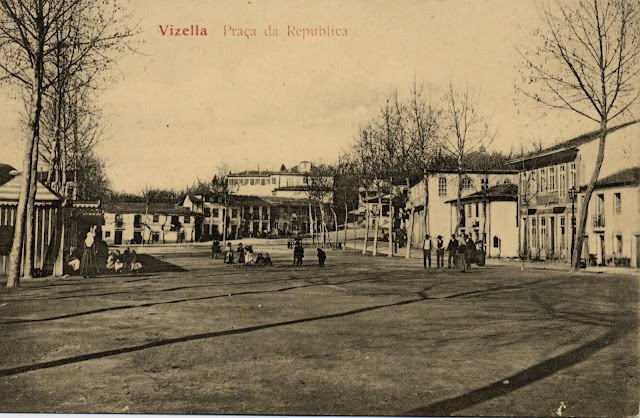
Guided by a muleteer, he had crossed the Falperra mountains, cut through by "deep ravines where water from the flowing streams splashed against the wooden stirrups," honeysuckle suspended in thick festoons from the mossy walls enveloping the travelers. The nocturnal landscape was enchanted: nightingales sang in the willows, from the mountain heights one could make out "the immense landscape that unfolds to the sea, bathed in moonlight" illuminating the white cottages of the Bom Jesus sanctuary, one heard "the moaning of pine trees and waves, interrupted at intervals by the tinkling of bells from a string of mules." He found "a most pleasant valley, covered with vegetation, shaded by oaks and chestnuts, surrounded by cornfields framed by rows of trees from which vines hang, bathed by the waters of the Vizela river." The settlement was divided into two banks connected by a stone bridge: Lameira (more populated) and Mourisco, where Ramalho lodged "in a small one-story house, with its continuous wooden veranda under a porch and suspended on stone pillars." Caldas de Vizela was then part of the Guimarães municipality, known since Roman times for the medicinal qualities of its waters, although only in the eighteenth century did they gain new scientific recognition, following the general European thermal renewal movement.
Ramalho's account of Caldas de Vizela constitutes one of the most lyrical and nostalgic moments in "Banhos de Caldas e Águas Minerais." Unlike the technical descriptions of chemical composition and therapeutic properties of the waters—conforming to the positivist and hygienist paradigm of the time—here sensory and emotional evocation prevails. The writer recalls with meticulous detail the first morning: opening the window at six o'clock, he sees in the enclosure the roosters "shaking themselves and crowing in the sun," the white rabbits gesticulating "eagerly beside a bundle of cabbages," the river flowing "between poplars and chestnuts," the round mill dressed "in moss and ivy, covered with a blackened thatch roof," the water falling into the weir "with a diligent and cheerful din." On the opposite hill, above the other bank, the small church of São Miguel das Aves with its whitewashed bell tower, and on the veranda of the parish residence the octogenarian rector—white hair, wool cap, unbuttoned cassock, short breeches, black stockings—accompanied by an eighteen-year-old girl, yellow kerchief with crimson foliage crossed over her chest, braids rolled at the nape inside a scarlet kerchief "according to the graceful local fashion," both feeding chickens, turtledoves, pigeons, sparrows, and a large macaw perched on the priest's shoulder. This scene possesses an almost pictorial quality, a studied visual composition that evokes the harmony between man and nature characteristic of rural Minho life. Ramalho does not hide that entertainments were scarce—"conversation at the pharmacy, at the barber's, at Bento's shop by the bridge"—but celebrates authenticity: fishing trips with mingacho, quail hunting, walks to Cascalheira, excursions to Braga, Guimarães, Fafe, pilgrimages to Bom Jesus, picnics, donkey rides. The season extended "from mid-May to the end of October," allowing bathers a prolonged immersion in that valley that represented the absolute opposite of urban life—no cosmopolitan sophistication, but genuineness and serenity.
Today, visitors to Caldas de Vizela—an autonomous municipality since 1998, with about 24 thousand inhabitants, economy based on textile industry, garments, footwear, and thermalism—find a profoundly altered reality. Thermal infrastructures have been modernized, proximity to Guimarães and Braga has integrated the town into the Ave urban fabric, thermal tourism has become professionalized. But the valley bathed by the Vizela river remains, the bridges remain, the millennial thermal vocation persists. The architectural heritage—the old Parish Church of Caldas de São Miguel, the Main Church of Santo Adrião, the Old Bridge over the Vizela, the Paço de Gominhães—evokes the centuries-old structure of that community Ramalho knew. Observing with "Ramalho's eyes," one is invited to reflect on the price of modernization: comforts and efficiency were gained, that inaugural morning was lost where roosters crowed, pigeons pecked fingers, and time was measured by the "diligent and cheerful" din of water falling into the weir. Caldas de Vizela remains a spa, but is no longer that untouched valley where a traveler arriving at night, guided by a muleteer through Falperra, discovered at dawn a still fully rural, authentic Portugal, prior to the modernizing agony that Ramalho sensed and documented with such melancholic acuity.