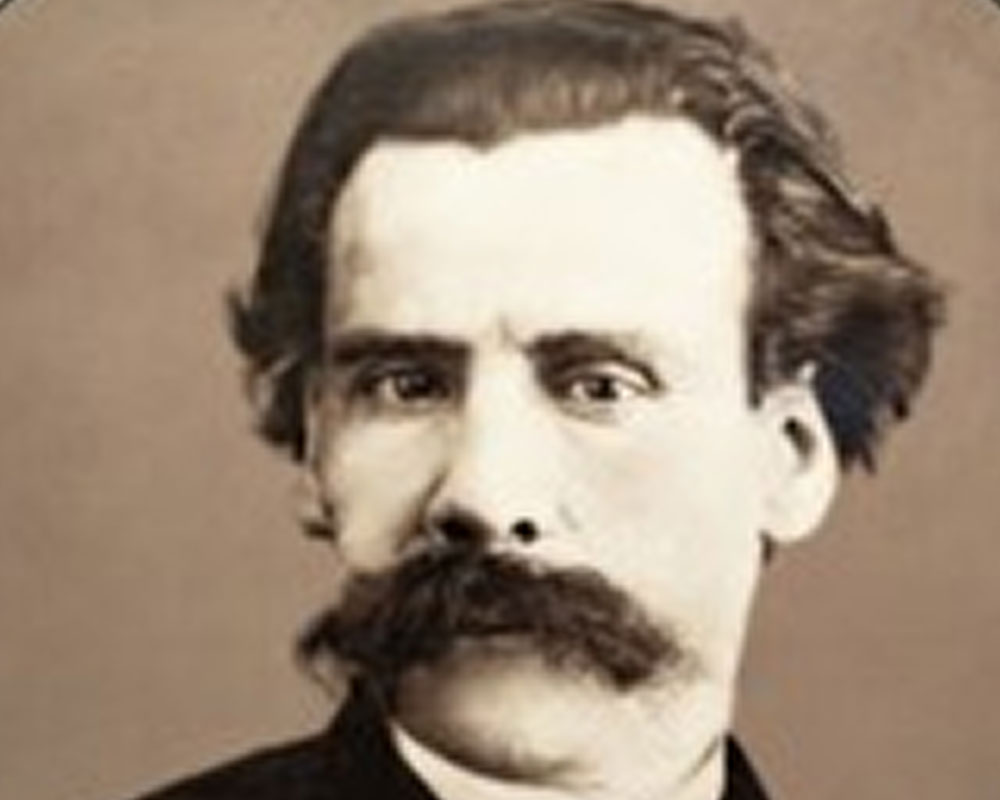
Lisbon, Orphanhood and Trás-os-Montes
Controversy accompanied Camilo from birth. Although records indicate 1825 as the year he came into the world on Rua da Rosa, in Lisbon, being baptized on April 14 at the Church of the Martyrs, the writer himself always claimed to have been born in 1826 – and contemporaries recognized him as such. Natural son of Manuel Joaquim Botelho Castelo Branco and Jacinta Rosa, orphanhood came to him early: he lost his mother on February 6, 1827 and his father on December 22, 1835.
"Tinha eu nove anos e era órfão", he would write decades later in *No Bom Jesus do Monte* (1864), a memorialistic book. Accompanied by his older sister Carolina, he was taken to Vila Real, to the house of his paternal family, taking shelter under his aunt Rita Emília. He had attended in Lisbon the school of master Minas Júnior, where he had as a classmate the future Count of Ouguela.
Vilarinho da Samardã: The First Masters
Between 1839 and 1840, in Vilarinho da Samardã, living with his sister who had married a medical student there, he lived with the latter's brother, Father António José de Azevedo, a fundamental figure in his formation. This clergyman taught him the rudiments of music, the principles of the French language and initiated him in the reading of the classics: the *Travels of Cyrus*, the *Theater of the Gods*, *The Lusiads*, the *Peregrinations* of Fernão Mendes Pinto. Village life and memories of his childhood in Trás-os-Montes would permeate his narratives, all endowed, in one way or another, with autobiographical character or fictionalized accounts of incidents the writer witnessed or were narrated to him by the protagonists themselves.
Early Marriage and Bohemian Life in Porto
At only sixteen years old, in August 1841, he married in Friúme, a village in the municipality of Ribeira de Pena, Joaquina Pereira de França, fourteen years old, where he began living working as a clerk in a notary's office. Meanwhile he lost part of his paternal inheritance. In 1843 he returned to Vilarinho da Samardã. The daughter born from the marriage and his wife died shortly after, with Camilo having abandoned both.
In October 1843, in Porto, he took exams in Humanities subjects and enrolled in the Medical School and the Polytechnic Academy, but would not complete his medical studies. From 1844 he began to live the literary and bohemian life of Porto, making his debut as a journalist. He began publishing articles in the city's periodicals – *O Nacional*, *O Eco Popular*, *O Jornal do Porto*, *A Semana*, *O Portugal*, *O Portuense*, *O Mundo Elegante* – an activity he would never abandon and would exercise until the end of his life.
He initially signed with the initials C.C.B., but used numerous pseudonyms and creative signatures, establishing himself as a poet, chronicler and prose writer: Um Académico Conimbricense, Anastácio das Lombrigas, Anacleto dos Coentros, O Antigo Juiz das Almas de Campanhã, José Mendes Enxúndia, Rosário dos Cogumelos, Manuel Coco, João Júnior, Barão de Gregório, among many others.
In 1845 he published *Os Pundonores Desagravados*, a heroic-burlesque poem, and in 1847 the historical drama *Agostinho de Ceuta*. He tried in 1846 to attend Law in Coimbra, a project thwarted by not being admitted to the University. Following the revolt of Maria da Fonte, he allegedly fought alongside the Miguelist guerrilla, which, according to some biographers, earned him the appointment as clerk of the Civil Government in Vila Real, but he fled the city after publishing in the Porto newspaper *O Nacional* two letters against the Civil Governor.
Patrícia, Prison and the Birth of a Writer
Settled alone in Porto, he revealed himself to be a polygraph of rapid writing. Returning to Vila Real, he met Patrícia Emília de Barros, with whom he fled. Accused of kidnapping and embezzlement, Camilo and Patrícia, who were living together, were imprisoned in the Relação Prison of Porto. From this relationship resulted the birth of a daughter, Bernardina Amélia, in 1848.
In 1848 he published, in a pamphlet under anonymity (Mandada Imprimir por Um Mendigo), an account where the narrator figure that would give the Camilian stamp to later novels and novellas was already present: *Maria! Não me Mates Que Sou Tua Mãe!*, inspired by a crime that occurred in Lisbon.
Lisbon, the Clergy and the Mysteries
In 1850 he was back in Lisbon, where he began his career as a polemicist with the pamphlet *O Clero e o Sr. Alexandre Herculano*, defending his writer friend. He said he was, by profession, "escritor público". That year he published at the National Press his first novel, *Anátema*, and the writing of other novels, as well as collaboration and founding of various newspapers, marked his total dedication to the craft of writing.
He enrolled between 1850 and 1851 in the course of Theological Sciences in Porto. In 1852 he was co-founder of the newspaper *O Cristianismo*, submitted to examination to obtain minor orders but, due to the adventurous life he had led until then, these were refused him. He abandoned the course of Theological Sciences – impossible love for a married woman had almost led him to embrace the priesthood.
Between 1853 and 1854 he published, first in serial form in the Porto daily *O Nacional* and finally in volume, *Mistérios de Lisboa*, a response in the panorama of Portuguese literature to *Les Mystères de Paris* by Eugène Sue (1842-1843). Most of his novels would be initially published in serial form, in periodicals, before appearing in volume, as was the practice at the time.
Ana Plácido: The Impossible Love and the Second Prison
He had met Ana Augusta Plácido, married to Manuel Pinheiro Alves, a woman who would become his companion and muse. The relationship between the two was severely censured by Porto society: Ana was married to a man respected in the city and sister-in-law of Bernardo Ferreira, son of the famous Ferreirinha da Régua. Camilo's writings began to be refused by Porto newspapers, leaving him without means of subsistence.
He was obliged to compete in 1858 for the position of second librarian at the Municipal Public Library of Porto, failing to be admitted, even counting on the protection of Alexandre Herculano, who that year proposed him as corresponding member of the Royal Academy of Sciences, with the intention of rehabilitating his friend's name.
After Ana Plácido gave birth to a son, presumably Camilo's, Pinheiro Alves filed an adultery suit against the two lovers. In 1859 they both moved to Lisbon, but before the end of the year they returned to Porto. In October 1860, both were imprisoned in the Relação Prison of Porto.
It was Camilo's second stay in that prison. This time, already a consecrated writer, he received visits from the young king D. Pedro V, translated various works by foreign authors and composed several of his best-known novels. *Amor de Perdição*, written in only fifteen days (possibly near the end of 1861, with the date 1862 printed on the cover), "os mais atormentados da [sua] vida", would be considered by Miguel de Unamuno as the greatest romantic work of the Iberian Peninsula. He also wrote *Romance dum Homem Rico* and *Doze Casamentos Felizes*. The memories of the Relação were fixed in *Memórias do Cárcere*, a book in which he gave account of the many figures he met there, namely the famous José do Telhado.
In October 1861 he was tried and acquitted.
São Miguel de Seide: The Refuge and Vertiginous Writing
After the acquittal, the birth of their son Jorge (1863) and the death of Pinheiro Alves – who left his wife an inheritance in money and various properties – the two moved in 1864 to the Quinta de São Miguel de Seide, where their third child, Nuno, was born. This would be Camilo's permanent residence until the end of his life, in the company of Ana Plácido. The house would become his refuge and, later, the scene of his tragic death.
Camilo continued to write vertiginously – he came to publish six novels a year, in addition to journalistic collaboration. Here he wrote some of his most striking works: *Amor de Salvação* (1864), *A Queda de Um Anjo* (1866) – biting satire of Portuguese political life –, and the historical novels *O Judeu* (1866) and *O Senhor do Paço de Ninães* (1867), whose action unfolds from the departure of D. Sebastião for Alcácer-Quibir to the conquests in India.
In the 1870s, he published the celebrated *Novelas do Minho* (1875-1877), which brought him closer to the new realist school, previously programmatically inaugurated by the young Eça de Queirós, integrating him fully into the movement. In 1876 he published a notable *Curso de Literatura Portuguesa*.
The "Facetas" Imitations and the Son's Madness
The manifestations of madness of his son Jorge and the difficult conditions of subsistence obliged him, in 1871, to make a first auction of his library. Publications followed, especially adapted translations, without the name of the original author.
In 1879 he returned to controversy, this time resulting from the *Cancioneiro Alegre de Poetas Portugueses e Brasileiros*, an anthology whose criticisms earned him a response in the volume *Os Críticos do Cancioneiro Alegre*. That year he published *Eusébio Macário* which, with *A Corja* (1880) and *O Senhor Ministro* (published in *Narcóticos*), constituted a series of "facetas" imitations of the naturalist style then in vogue, presenting themselves with the objective of making "destroços" "nas pequenas fileiras realistas". *A Brasileira de Prazins* (1882), the last of the collection, is however considered as a masterful adaptation of the already old and consecrated Camilian writing to the characteristics of the new realist program. In a final novel, *Vulcões de Lama* (1886), he ridiculed the realist school, staging various types of Portuguese society of the time.
The Final Years: The Viscountcy and Blindness
After several efforts, he was made Viscount of Correia Botelho by law of July 20, 1885, a title granted by King D. Luís. He was also appointed Corresponding Academician of the Royal Sevillian Academy of Fine Letters on April 1 of that year. He had previously received the Order of the Rose from the Emperor of Brazil, D. Pedro II (1872).
The ophthalmic disease that had declared itself years before progressively worsened. His health problems, especially difficulties in vision, were increasingly serious. Despite increasingly assiduous consultation with doctors in Porto and Lisbon, the debility of his condition intensified.
He finally married Ana Plácido on March 9, 1888, after decades of living together. He obtained the following year a life pension for his son Jorge, whose madness was irreversible. He sent to his friend Freitas Fortuna a letter that he himself considered as a "cláusula testamentária", with provisions about his "cadáver" and the place where he wanted to be buried.
In 1889, the writer who had never ceased to collaborate and participate in the creation of magazines and periodicals founded with Tomás Ribeiro *O Mensageiro*, whose inaugural issue was "consagrado a Sua Majestade Imperial o Sr. D. Pedro d'Alcântara". He gathered a set of memorialistic texts in *Delitos da Mocidade*.
The Tragic End
According to J. Viale Moutinho, he had written to the specialist requesting that he visit and examine him with these words: "Sou o cadáver representativo de um nome que teve alguma reputação gloriosa neste país, durante 40 anos de trabalho. Chamo-me Camilo Castelo Branco e estou cego."
He was buried in Porto, in the Lapa cemetery, in the tomb of his old friend Freitas Fortuna. The death certificate records that he died at 64 years of age. *Nas Trevas. Sonetos Sentimentais e Humorísticos* was the last book by the writer published during his lifetime.
The Immeasurable Legacy
The writer who had never abandoned journalistic activity, the polygraph of vertiginous writing, left a work of about two hundred novels or novellas, countless articles, chronicles, texts of dissemination or criticism of writers, painters and composers, pamphlets, broadsides, prefatory texts, vast correspondence and also a good number of translations of foreign works, especially French. In the novel, the genre he most practiced, Camilo wrote at the border between romantic idealism (but already, in a certain way, under the influence of the realist current) and the attempt to achieve the aesthetics of the naturalist generation, first in the form of stylistic pastiche, later as adhesion (albeit reactive) to a movement which, deep down, he disdained.
The turbulent life – marked by forbidden passions, prisons, controversies, economic difficulties, family tragedies – merged indissolubly with the most vast and diversified literary work of the entire Portuguese nineteenth century, leaving a legacy that continues to fascinate readers and scholars for its intensity, authenticity and unrepeatable creative genius.