In Cuba, an Alentejo locality, Fialho de Almeida's tomb displays at the top a sculpture of two cats – a biting allusion to his most celebrated work, The Cats, and perfect symbol of someone who had affirmed in the preface of that same work his way of being in life and literature: "miando pouco, arranhando sempre e não temendo nunca".
From Alentejo to the Capital: Formation of a Restless Spirit
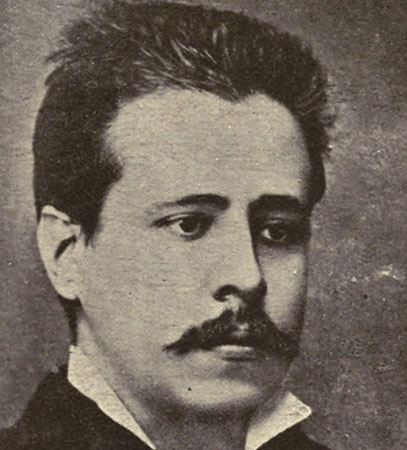
The story begins on May 7, 1857, in Vila de Frades, an Alentejo village that would give birth to a striking personality. Son of a small landowner, young Valentim was sent to Lisbon in 1866, at nine years old, entering the European College, an educational institution he attended until 1871, where he obtained interesting grades.
The interruption of his studies due to economic difficulties forced him to seek work. He became a pharmacy apprentice in a Lisbon apothecary located near Campo de Sant'Ana. This life circumstance, as he himself recounts in his autobiography, allowed him to enter into "contacto absoluto com o povo" and sharpened in him "uma tendência mórbida para as letras". The pharmacy proved to be a school of life: there he daily observed human misery, diseases, vices, bourgeois hypochondria, and the resignation of the poor.
Literary Debut and Academic Journey
His debut in the world of letters happened in 1873, when he published his first texts in the newspaper Correspondência de Leiria. Determined to complete his academic training, he passed through the French Lyceum and the Polytechnic School, graduating in Medicine between 1878 and 1885.
Paradoxically, upon completing this stage of his academic journey, he did not draw professional consequences from it. He would not practice medicine, although some marks of confidence in the scientific spirit and the clinical eye that dissects reality remained in his aesthetic-literary sensibility. He then devoted himself entirely to writing and journalistic activity, deciding to live by the pen "donde continuamente espirravam revoltas".
Lisbon: The Loved and Hated City
His stay in the capital – described by him as "cidade de frades, beatas e desembargadores" – would be imprinted on many provocative pages. He frequented cafés and gatherings, socializing with the intellectuals of the time, absorbing ideas and engaging in controversies. During this Lisbon period, he published the first volume of Tales (1881), followed by The City of Vice (1882), a collection of realist inclination where the narrator presents himself as "peregrino" through "campos e terreolas", gathering a "singular lucidez" from the fact of not even reading newspapers.
Later, he would publish Gallant Lisbon (1903), a caustic portrait of Portuguese urban society, counterpoint to the benevolent vision he cast upon the humble, upon those who lived off the land. The capital simultaneously fed his inspiration and repulsion.
The Merciless Polemicist
If the letter published in 1880 in the magazine A Crónica, in response to Pinheiro Chagas' text, already represented a strong position-taking in the literary domain, Fialho would come to sharpen a sharp, even merciless gaze, revealing a certain misanthropic pessimism. With scalpel at the ready, and seduced, according to A. Cândido Franco, by Queirosian positivism, he denounced character traits and moral deformities, discovered malformations and bestialized some social types, in an analysis sometimes punctuated with crudeness. A cultivator of brief narrative and writings of pamphlet-like and critical flavor, he stood out especially as a short story writer and chronicler, not without guarding against the remarks of readers who prefer the "fabricantes de calhamaços". He was straightforward, said what he had to say, whether they liked him or not. He pointed out defects both in the Constitutional Monarchy and in the First Republic. His strokes of genius were evident, but they also attracted considerable enmities. He remained impartial and did not align with partisanship.
The Confluence of Aesthetics
In him converged influences from the naturalist creed, shades of rustic realism born from the "sentimento da paisagem" and the benevolent gaze he cast upon the humble – think, for example, of Reapers –, as well as aspects of the decadent aesthetic, namely the taste for morbidity. It is the author himself who confirms his inclination to "intrometer fezes humanas nas tintas duma paleta".
Vast and uneven in its conception, influenced by various literary currents, the work does not shy away from dysphemism, caricature, treatment of the aberrant and sordid, often presenting the human being inflamed with vile passions or by lust that makes him abject. Privileged themes included urban life, vices, poverty, decadence, and the quiet, realistic life of Alentejo. Unforgettable Characters
In the light of naturalist aesthetics, but also through the decadentist sieve, he constructed memorable characters: Carolina, known by antonomasia as the Redhead, who stars in the story of the same title; João da Graça, protagonist of Three Corpses, a student and future doctor who embodies the dissector of souls who believes he finds in those destinies the reflection of a petty and hypocritical environment.
The Cats: The Magnum Opus
His most notable work is titled The Cats, written between 1889 and 1894, a collection of biting chronicles that received significant reception from the Portuguese population. Also well known are the works The Country of Grapes (1893) and the aforementioned The City of Vice (1882). Some researchers considered him an artist of anarchic nature, demonstrating revolt against everything and everyone, systematically adopting criticism and satire in his texts.
The Return to Alentejo and the Brief Marriage
In 1893, he returned to his region, having married a wealthy woman, Emília Pego, native of Cuba (Alentejo). However, she died the following year, victim of tuberculosis. Subsequently, Fialho was a farmer, but never stopped publishing articles for newspapers and various chronicles and stories.
After his wife's death, he undertook some trips through Europe, which enriched his knowledge and broadened horizons. In these travels, he absorbed influences and perspectives that would nourish his later writings.
The Legacy of a Reputed Writer
In his works, he described the problems affecting society and presented proposals to overcome them, which would notably involve the education and instruction of the people, making possible an enlightened public opinion, in order to combat ignorance, decadence, and corruption. His texts constitute important sources that allow analysis of the experiences of that critical period in Portugal, in which the transition from Monarchy to Republic took place.
The recognition of his career is still visible today. His name is remembered in countless localities, namely in his birthplace, Vila de Frades (and in the rest of the Vidigueira municipality), where there is a sculpture and even toponymic records in his memory.
When he died prematurely in 1911, he left a fundamental legacy to Portuguese literature: a unique writing, without concessions, that did not fear to scratch the wounds of Portuguese society. The style he adopted would merit the respect and fear of many. He was what he proclaimed himself to be: a cat that meowed little, scratched always and never feared – tutelary figure of a combative literature, committed to truth, however uncomfortable it might be.