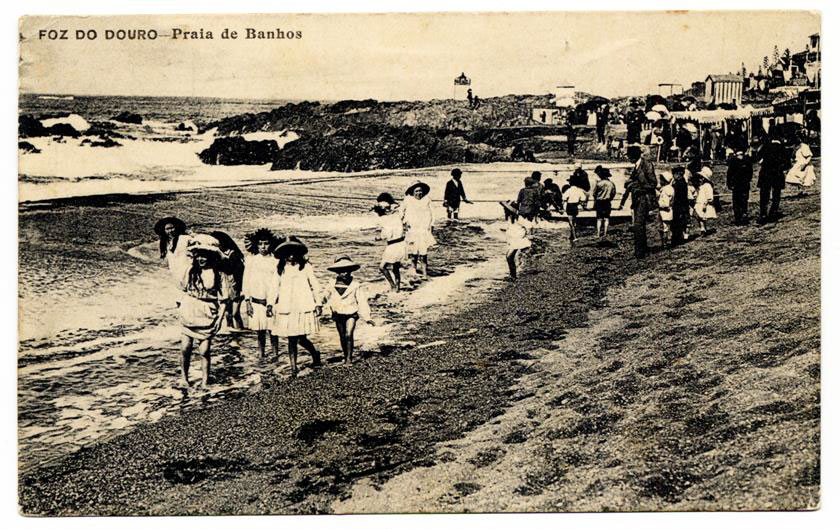
The Porto families who traveled there in summer faced a true expedition: heavy ox-drawn wagons departed at dawn from Carmo or Porta Nobre, taking bathers on a journey that consumed the entire day, round trip included. Ramalho would later recall, with his usual irony, that the wagon was too sluggish for a journey that had to be made, there and back, in the same morning, which is why some families preferred the donkey train.
The facilities were of the most extreme rusticity. Two inns—Julião's, opposite the Castle, and Silvestre's, at the end of Rua Direita—constituted all the available accommodation, complemented by the Senhora da Luz café and the Mallen Assembly, at the corner of Praia dos Ingleses. The daily life of the summer visitors was of an almost archaic simplicity:
Having breakfast, having lunch, drying one's hair, is the ordinary occupation of bathers on this beach, from eight o'clock in the morning until the end of the afternoon.
The Beaches of Portugal
Favorite walks were limited to the Senhora da Luz lighthouse in the morning, the fair during the day, and the Cantareira in the afternoon, when the fish boats arrived. As for eating habits, the writer left us this delightful description:
In the morning, after bathing, at eight o'clock, we had breakfast with coffee and milk, bread with fresh butter (...) At noon we had lunch. At the Ave-Marias, we would cross ourselves, pray the Angelus at the church bell's toll, and have tea with bread from Vilar and cookies from Avintes.
The Beaches of Portugal
Foz in Accelerated Growth
The 1870s brought a radical transformation. The inauguration of two tramway lines—the American one—decisively brought Foz closer to Porto, reducing the journey to about thirty minutes. This advance triggered a remarkable increase in bathers and unleashed the transformation of the old fishing village into a residential suburb of Porto's bourgeoisie.
The social character of the beach diversified: to Porto's commercial bourgeoisie were added the landowning families from the Douro, who came to spend the bathing season, and the English colony, which chose Praia dos Ingleses as its preferred retreat, seeking the tranquility that the growing influx of bathers had compromised in the central beaches.
Without Bathing Services
Ramalho was an implacable critic of the deficiencies in the so-called bathing establishments:
Balnealization is done in an entirely primitive manner" (...) When a bather shows symptoms of asphyxiation or congestion, which is common, there are no therapeutic resources to assist them. There is no hot water service. Bathers, to remove the sand from their feet, generally wash them in cold water when the reaction begins.
The Beaches of Portugal
The absence of hygienic and therapeutic measures contrasted sharply with the practices of European seaside resorts, which the writer knew well from his travels. The lack of a true bathing establishment, with adequate facilities, doctors present, and complementary treatments, reduced the bathing experience to a mere dip in the sea.
This evolution reveals a profound change in the very conception of sea bathing. If in the early times of the century the therapeutic character still predominated, progressively the leisure dimension imposed itself. Foz was becoming less a place of healing and more a space of bourgeois sociability, where Porto families displayed their social position, cultivated relationships, and indulged in the pleasures of seaside life. Ramalho witnessed and documented this transition with his incisive pen, recording for posterity that "Old Foz" which in a few decades would cease to exist, absorbed by the city's urban expansion.