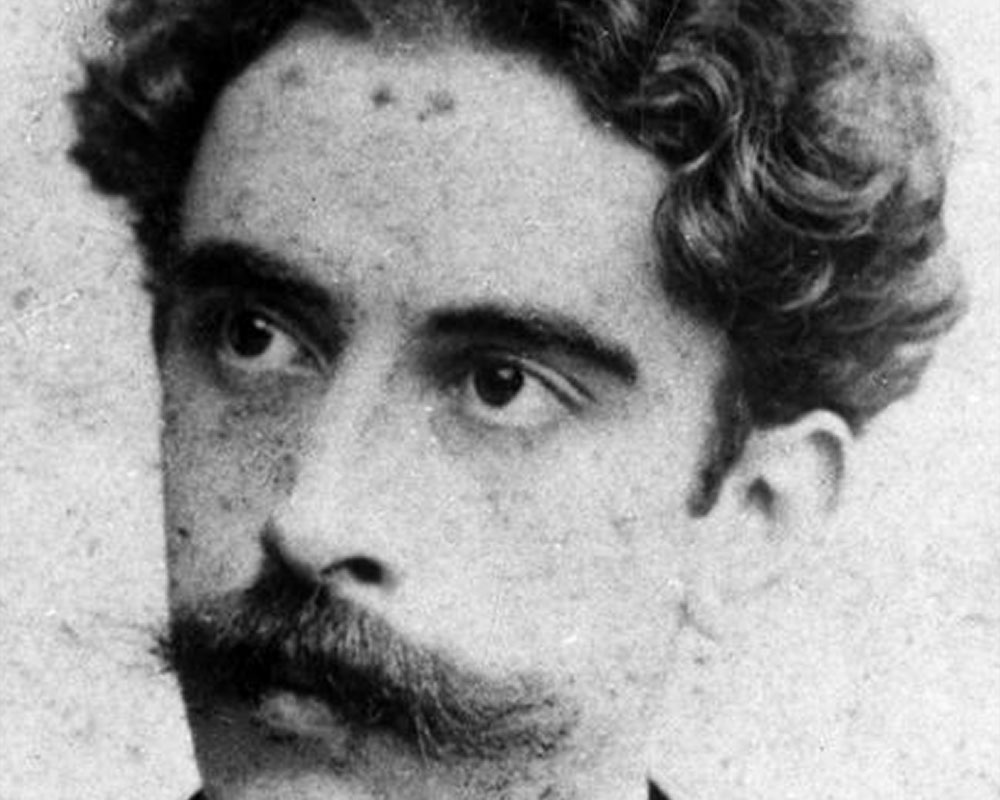
His story is that of a man born in Lagos in 1876, who built a dazzling and contradictory career, until his death in Lisbon in the year 1962.
The Attack That Went Down in History
In 1916, a young artist named José de Almada Negreiros launched the incendiary "Manifesto Anti-Dantas", a public assault against the already consecrated writer. This episode became a landmark of early Portuguese modernism, and its repercussions spanned decades. Even today, mentioning Júlio Dantas provokes an embarrassed silence in certain literary circles – eloquent proof of how a generation of modernists managed to tarnish the reputation of someone who had been, for years, one of the most appreciated Portuguese authors beyond borders.
But who really was this man who aroused such controversy?
Family Roots and Formation
Son of Casimiro Augusto Vanez Dantas – himself a military man, writer and journalist – and Maria Augusta Pereira de Eça, Júlio grew up in an environment where the written word and military life naturally intertwined. In 1887, at only eleven years old, he was admitted to the Military College of Lisbon as student number 114, beginning a trajectory that would combine military discipline and literary vocation.
He chose Medicine, enrolling in the Medico-Surgical School of Lisbon. The course culminated in 1900 with the defense of a thesis curiously titled "Pintores e poetas de Rilhafoles" – Rilhafoles was the popular name of the Miguel Bombarda Hospital, a Lisbon psychiatric institution. Two years later, in 1902, he entered the Portuguese Army as a medical officer, specializing in psychiatry.
A Multiple Life: Between the Office and the Stage
Military medicine never absorbed him completely. While practicing psychiatry, Dantas simultaneously plunged into a feverish intellectual activity that would make him an unavoidable figure in the cultured salons of the capital and in the political circles of the time. In 1905, he made the leap to deputy to the Courts, beginning a political career that would lead him, over the years, to occupy the ministerial portfolio four times and to represent Portugal in various diplomatic missions.
But it was in theater that he achieved the most resounding triumphs. "A Severa", premiered in 1901, conquered audiences. "A Ceia dos Cardeais", from 1902, became an international phenomenon, being translated into more than twenty languages – a rare feat for a Portuguese author. These were followed by "Rosas de Todo o Ano" and "O Reposteiro Verde" (1921), consolidating his position as a successful playwright.
The Tireless Polygraph
Versatility was his trademark. Beyond theater, he ventured into poetry (his first book of verses appeared in 1897), the novel, the short story, the chronicle and the essay. His first article had been published in 1893, in the newspaper "Novidades", when he was only seventeen years old.
Stylistically, he navigated between romanticism and Parnassianism – that poetic current that privileged formal perfection and descriptive beauty. His narratives and theatrical plays privileged historical themes, with special predilection for the eighteenth century, an era he recreated with meticulousness, exploring eighteenth-century aristocratic decadence. However, works such as "Paço de Veiros" (1903) and "O Reposteiro Verde" revealed a naturalist inclination, approaching a cruder and more realistic observation of society.
His poetry drank directly from the palace lyrics of the "Cancioneiro Geral" by Garcia de Resende, a sixteenth-century compilation that had gathered the poetic production of the Portuguese court. In his works, he cultivated heroism, elegance and love, but also the exaltation of the ephemeral, of death and of an intense sentimentalism.
The Man of Positions and Honors
The list of official positions he occupied is impressive: Government commissioner at the Teatro Nacional D. Maria II, professor and director of the Dramatic Art Section of the National Conservatory, superior inspector of Libraries and Archives. In 1908, he was received as a member of the prestigious Academy of Sciences of Lisbon; fourteen years later, in 1922, he ascended to the presidency of the institution, a position he would maintain almost for life.
The Paradox of a Contradictory Man
This accumulation of honors and the solemn posture – some would say stiff and self-complacent – with which he assumed his official role made him a perfect symbol for the young modernists to attack. Júlio Dantas came to represent, in the eyes of many, the conformist writer in the service of the Estado Novo, the beatified ornament of an authoritarian regime that promoted him and promoted itself with him. However, reducing this literary figure to such a caricature would be profoundly unjust. The play "Santa Inquisição" (1910) reveals a violent, almost ferocious anticlericalism, an iconoclastic and revolutionary spirit that contrasts strongly with the pomp of his mature years. The author of "Pátria Portuguesa" (1914) had been, in his youth, a frondeur – a French term designating a rebel, someone who challenges established authority.
A Legacy of Elegant Prose
One cannot ignore the quality of his writing. In an era when – as critics note – writing in Portugal was so poor, Dantas' prose maintained an Attic purity (that is, a classical simplicity and elegance) drawn from a solid humanist formation. Works such as "Pátria Portuguesa" (short stories), "Os Galos de Apolo" (chronicles, 1921) or "Tribuna" (speeches, 1960) continue to offer lessons in literary elegance.
A novel like "A Severa" demonstrated genuine narrative sensitivity. His plays continued to be performed for decades, conquering audiences who found in his historical recreations a romantic escape and a celebration of traditional values.
The Verdict of Time
Júlio Dantas remains an uncomfortable figure in Portuguese literary history: too established for the modernists, too attacked to be serenely reevaluated. He was a polygraph in the fullest sense – someone who wrote about everything and for all genres. He was a doctor, diplomat, academic, deputy, minister. He was loved and detested.
Perhaps his greatest misfortune was to live in a time of transition, serving as a bridge – and a target – between the literary world of the nineteenth century and the avant-gardes of the twentieth century. His work deserves to be read not as monument nor as error, but as testimony of a time and of a man who, with all his contradictions, indelibly marked Portuguese culture.