Article
Article
Looking at the Window Today, with Ramalho Ortigão
What does it mean, today, to affirm that the Tomar window is "the most Portuguese work"?
The question is more complex—and more dangerous—than it seems. Ramalho used the expression in a context of defensive nationalism, seeking to prove that Portugal possessed a very particular artistic specificity.
But the advent of the twentieth century, with its wars and nationalist catastrophes, taught us to distrust essentialist identity discourses, uncritical celebrations of "national genius," attempts to lock art in an ethnic cage.
The Tomar window is Portuguese, not because it expresses some immutable racial essence, but because it condenses in a singular architectural form an unrepeatable historical experience: that of a small Iberian kingdom that, for a few decades, managed to articulate a commercial and military network on a three-continent scale, financed by a medieval religious order transformed into a capitalist corporation.
That experience left marks—in institutions, language, cuisine, music, literature, architecture. The Tomar window is one of those marks. Not the only one, not necessarily the most important, but certainly one of the most eloquent. And recognizing its "Portugueseness" is not yielding to narrow nationalism, but accepting that history produced differences, particularities, idiosyncrasies that deserve to be understood, preserved, transmitted.
But if we look at it with Ramalho Ortigão's eyes, the "Portugueseness" of this window resides not only in the decorative motifs (cork oaks, cork, Alentejo bells). It resides above all in the attitude that presided over its creation: the capacity to synthesize heterogeneous elements—structural Gothic, Renaissance ornamentation, Oriental iconography, Atlantic references—into a living composition.
This capacity for synthesis can be read as a historical characteristic of Portuguese culture—not exclusive, certainly, because all cultures are, in varying degrees, eclectic, but particularly accentuated in a country that was, for centuries, a porous frontier between distinct civilizational worlds.
The invitation we extend to the visitor of the Convent of Christ, in Tomar, is, above all, an invitation to direct experience. No text, however meticulous in description, however sophisticated in analysis, substitutes for the physical confrontation with the work.
Seeing with One's Own Eyes
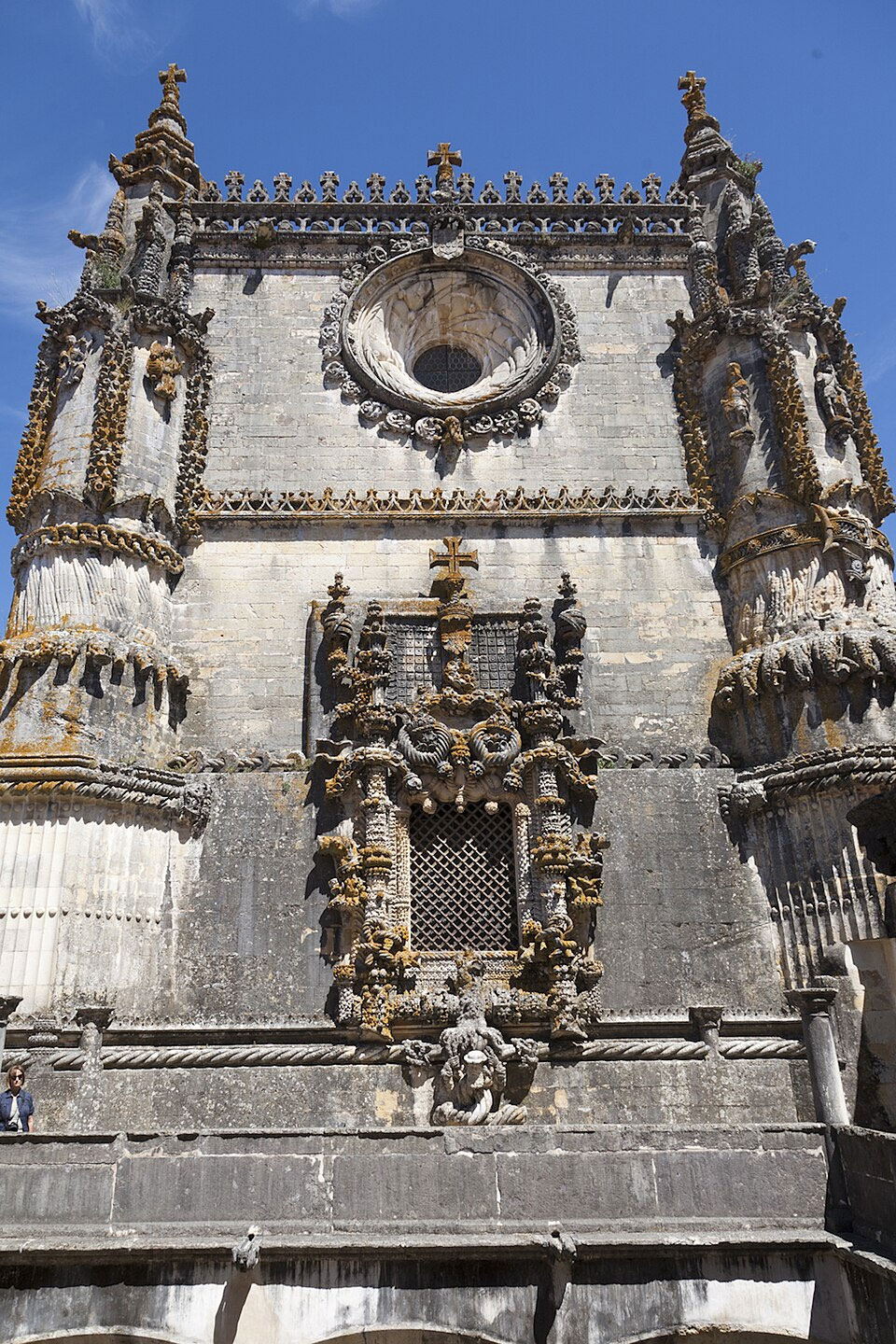
It is necessary to go to Tomar, climb the slope to the Convent of Christ, cross the successive layers of construction—from the Templar walls to the Renaissance cloisters—stand in the courtyard before the eastern façade, and see. See with your own eyes the window that Diogo de Arruda sculpted and that Ramalho Ortigão described.
See how the oblique morning light—it is best to go very early—coming from the east, falls on the limestone, highlights the reliefs and creates shadows that transform the two-dimensional surface into a three-dimensional landscape of impressive richness.
See how, by moving laterally, the visitor discovers details that were not visible from the center, realizes that the window changes according to the point of view, that there is no privileged perspective from which the entire composition becomes transparent.
See, also, the signs of time: the erosion of the stone in certain areas, the lichen stains, the more or less successful repairs that successive "restorations" have left.
A Window Touched by Time
The window we contemplate today is not exactly the same one that Arruda delivered in 1515, nor the one that Ramalho saw in the late nineteenth century. It is an architectural document on which each era inscribed its interventions, its care and its carelessness. And this temporal dimension, far from impoverishing the work, enriches it.
But seeing with one's own eyes can also be seeing with Ramalho, through the descriptive categories he established, but also beyond him, seeking the meanings that our era can discover and that the nineteenth century did not anticipate.
The window remains an inexhaustible enigma precisely because it resists interpretive closure. Ramalho saw in it the apogee of empire and proof of national artistic singularity.
We, who live in a post-colonial, post-imperial, European and globalized Portugal, can see other things: the moral ambiguity of an empire built on slavery and violence; the cultural hybridity of a nation that has always been, itself, frontier and synthesis; the fragility of all imperial ambitions, condemned to leave as the only lasting vestige not the dominated territories but the works of art created.