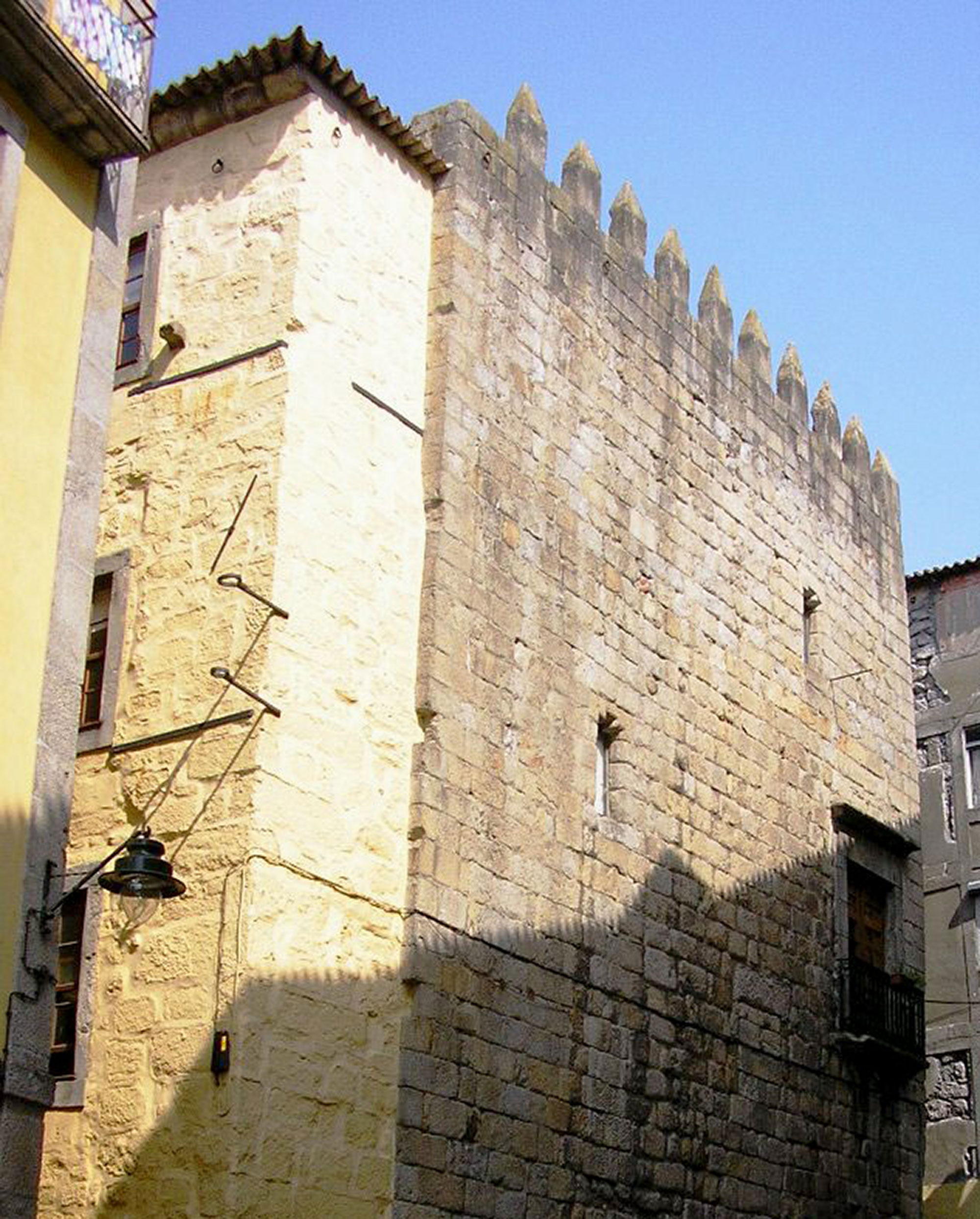
His descriptions of old Porto retain an almost archaeological quality. Consider, for example, his description of the Bainharia area, so named because for centuries it was home to sheath-makers, artisans dedicated to crafting sword sheaths. In the mid-19th century it was still thus, in Ramalho's eyes:
it was almost exclusively inhabited by tinsmiths. It had an entirely golden tone produced by the refraction of light on the basins, pots, three-wick lamps, in polished copper, hanging at the doorways; and the constant hammering of wires was enlivened by the same laborious and cheerful noise of the time when Aninha lived nearby, at the blessed arch of Nossa Senhora de Sant'Ana.
Figuras e Questões Literárias
.jpg)
The Reboleira, narrow and winding, with its enormous granite flagstones, closed at the edge of the sea by the Gothic arch of the Porta Nobre, and at three in the afternoon, in Summer:
it was already enveloped in a twilight shadow, and the pungent and appetizing smell of staves being beaten by coopers at the door of each shop gave it the refreshing sensation of a wine cellar.
Figuras e Questões Literárias
The pickaxe of progress
However, this picturesque Porto disappeared under the pickaxe of progress. Ramalho witnessed the demolition of the Arcos de Vandoma, the Postigo de Santo António do Penedo, the Porta Nobre, the Porta do Olival and the Viela das Tripas, that where the tripe sellers who gave the people of Porto the name of tripeiros lived. In their place arose the wide streets of Mousinho da Silveira and Passos Manuel, the new neighborhoods of Palácio and Duquesa de Bragança, modern buildings but frequently devoid of character. The traditional townhouses, however, still survived in many areas, with slate roofs, facades covered in azulejo tiles, granite lintels so cleanly squared, giving the whole a sturdy, healthy, cheerful air, harmonizing well with the fresh tones of the landscape.
Tireless defender of national heritage
Ramalho's lamentation was not, however, that of an inconsequential nostalgic. As an art critic and active defender of Portuguese heritage, he participated in national monument commissions, wrote technical reports on restorations and interventions, and published studies such as O Culto da Arte em Portugal (1896), where he systematically denounced the attacks committed against the nation's architectural heritage.
His attention extended from great monuments to decorative art objects, having played a relevant role in cataloging the royal collections for the Ornamental Art exhibitions of 1882 and Sacred Art of 1895. His interest in Portuguese primitive painting and the minor arts — goldsmithing, tilework, furniture — was part of a broader movement to rediscover national heritage that mobilized intellectuals such as Joaquim de Vasconcelos.
What Ramalho most deplores is the loss of that good and healthy provincial smell that so especially permeates like an ancient aroma the prose of its great writers — Garrett's O Arco de Santana and some of the bourgeois novels of Camilo Castelo Branco and Júlio Dinis. With the modernization of the city disappeared not only the monuments but also the customs:
The old local customs disappeared with the sedan chairs of Lopes and Carneiro, with the small chairs of Rua do Almada, with the tarts from the pastry shop on Rua de Santo António, with the carts of Manuel José de Oliveira, with the Saint John's festivals of Lapa, Bonfim and Cedofeita, with the picnics up the river.
As Farpas I
It was an entire bourgeois and provincial way of life that was vanishing, replaced by a cosmopolitanism that Ramalho considered characterless and banal.