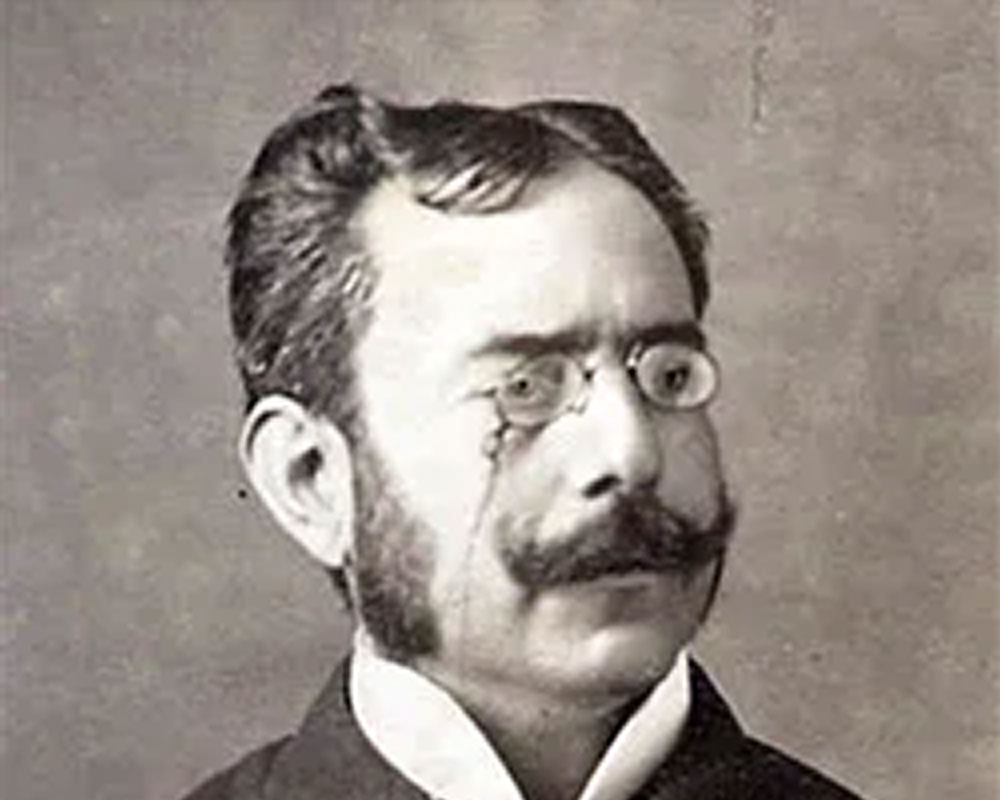
A Life Between Letters and Travel
When José Duarte Ramalho Ortigão died in 1915, at the age of 79, the journey of one of the most multifaceted figures of nineteenth-century Portuguese culture came to an end. A native of Porto, where he was born on November 25, 1836, Ortigão was the son of an artillery officer with roots in Alentejo and Algarve and a Porto woman from Paranhos. Being the eldest of nine siblings, he grew up on a rural property that he would always remember as the setting of an idyllic childhood.
Education and First Steps
His education unfolded under the peculiar tutelage of a family clergyman, Frei José do Sacramento, and a military veteran, Manuel Caetano, who had accumulated half a century of service in arms. From this dual influence was born a singular personality: pedagogical inclination and appreciation for discipline coexisted with a valorization of physical vigor and pragmatism. Ortigão himself identified with this duality, seeing himself simultaneously as friar and soldier.
The decisive moment for his literary vocation arose unexpectedly. During a prolonged recovery from illness, he encountered Almeida Garrett's work, Travels in My Land, which awakened his passion for writing. More than a stylistic influence, Garrett transmitted to him a lasting fascination with nomadism and the study of the national territory, anticipating what would become a pioneering ethnographic interest.
His time in Coimbra proved ephemeral and fruitless – he did not complete his Law degree. Returned to Porto, he assumed the teaching of French language at the educational establishment directed by his own father, the Colégio da Lapa. There he would shape notable minds, including the future novelist Eça de Queirós and the physician Ricardo Jorge. Simultaneously, he embraced journalism, writing literary criticism for Jornal do Porto, an activity that would become central to his professional path.
Controversies and Literary Duels
The 1860s brought him prominence in one of the most celebrated cultural controversies of the Portuguese nineteenth century. The Coimbra Question pitted generations and aesthetic visions against each other: on one side, young renovators like Antero de Quental and Teófilo Braga; on the other, established figures like António Feliciano de Castilho. Ortigão tried to position himself in the middle ground, publishing reflections that sought balance. The strategy failed: neither did the conservatives trust him, nor did the progressives forgive him for criticizing Antero. The disagreement escalated to a point of honor: the two faced each other in a duel at the Arca d'Água Garden, with Ortigão emerging wounded.
Family Life and Stability
His marriage to Emília de Araújo Vieira, celebrated in 1857, provided him with the domestic serenity he sought. Curiously, this companion seems to have remained on the margins of his artistic creativity. However, the couple's three children – Vasco, Berta, and Maria Feliciana – occupied significant space in his written reflections. The birth of his firstborn awakened in him a new sensitivity to the universality of the paternal experience.
The Partnership with Eça and the Phenomenon of As Farpas
Dissatisfied with the limitations of the provinces, where he felt misunderstood both economically and psychologically, Ortigão took advantage of an opportunity at the Academy of Sciences to establish himself definitively in Lisbon. It was in the capital that his collaboration with Eça de Queirós flourished, an old master-disciple relationship transformed into creative complicity.
The year 1870 marked the launch of The Mystery of the Sintra Road, a literary experiment that inaugurated detective fiction in Portugal. Despite its experimental character – the authors themselves would later renounce it as "execrável" – the work testified to the complicity between both.
More impactful was As Farpas, an editorial initiative launched in 1871 that would become the great work of Ortigão's life. Conceived as systematic criticism of Portuguese society, this periodical publication began as a joint project with Eça. When he departed for consular duties in Havana the following year, Ortigão assumed the endeavor alone, shaping it according to his characteristics: where Eça privileged demolishing sarcasm, Ortigão leaned toward didacticism. For seventeen years he maintained the publication, which would eventually be compiled into fifteen main volumes.
The Tireless Traveler
The passion for travel, characteristic of the era, found in Ortigão a fervent adherent. His first significant experience occurred in 1867, when he visited the Parisian Universal Exhibition, generating the book In Paris. But his interest was divided between the foreign and the national.
Regarding Portugal, he produced works that combined the useful with the pleasant: guides on thermalism and beaches that simultaneously served touristic purposes and public health promotion. His regionalist approach aimed at profound knowledge of the country.
International travels fed another ambition: the comparative exercise of civilizations. He traveled through Spain with almost religious devotion, particularly impressed by the Prado Museum. Italy revealed Rome to him as the supreme repository of Western culture, while Sicily seemed to him a stratified synthesis of all Mediterranean civilizations. England earned him John Bull, where he did not omit criticisms of British arrogance in Anglo-Portuguese relations.
But it was Holland, visited in 1883, that inspired what many consider his masterwork. For someone who never abandoned bourgeois convictions and pedagogical aspirations, the Dutch model represented everything Portugal should aspire to be: a paradigm of social organization, economic prosperity, and cultural refinement.
The Art Critic
Parallel to travel writing and social intervention, Ortigão developed notable competencies in artistic appreciation. He was possibly the first true Portuguese art critic, demonstrating intuitive sensitivity that still impresses today. His work The Cult of Art in Portugal (1896) and the studies dedicated to painters like Silva Porto and Malhoa, or the sculptor Soares dos Reis, maintain relevance.
He was particularly interested in decorative arts, an area where he contributed to the valorization of national heritage. The organization of the commemorative procession for the three hundredth anniversary of Camões' death (1880) exemplifies this taste for the ornamental, allied with a naturally festive temperament inclined toward luxury.
Decline and Exile
The last decades brought ideological transformations. The Generation of '70, initially cosmopolitan and reformist, evolved toward more conservative and nationalist positions. The old "Cenáculo" with a Proudhonian spirit gave way to the "Vencidos da Vida," a nostalgic group that met at the Hotel Bragança. Ortigão accompanied this evolution, increasingly influenced by Taine's naturalism and traditionalist regionalism.
The death of his lifelong companions – Oliveira Martins in 1894, Eça de Queirós in 1900 – closed essential chapters. The assassination of King Carlos I in 1908, a personal friend and admired artist, shocked him deeply. The fall of the monarchy and establishment of the Republic in 1910 completed his disenchantment: he resigned from his position as royal librarian and voluntarily exiled himself in Paris.
His return in 1912 found him alienated from public life, skeptical about the country's political future. He withdrew into family life, dying peacefully three years later, leaving an extraordinary legacy as a writer, journalist, educator, and acute observer of Portuguese society.