Article
Article
Ramalho Ortigão and the Cult of Art in Portugal
Ramalho Ortigão wrote in the late nineteenth century, at a time when Portugal had lost its empire, suffered the trauma of the British Ultimatum of 1890, discovered itself to be a peripheral power on a continent dominated by more populous, more industrialized, and more powerful nations. National monuments—Batalha, Jerónimos, Tomar—lay abandoned or were the object of "restorations" that Ramalho denounced as disguised vandalism.
Faced with this double ruin—the physical ruin of the monuments and the moral ruin of the nation that abandoned them—Ramalho could have chosen the paralyzing nostalgic lament that takes pleasure in contemplating lost splendor. He chose, on the contrary, combative pedagogy. He taught that heritage is not a dead relic to be preserved under a glass dome, but living memory that challenges the present and conditions the future.
The Tomar window does not serve merely to inform us about what Portugal was in the sixteenth century; it serves above all to question us about what Portugal is—and can be—in the twentieth and twenty-first centuries. When Ramalho insisted that the greatness of Manueline art resulted from the creative freedom of artists, from their courage to transgress canons, he was not merely doing art history. He was formulating a political and cultural program for his time: Portugal would only recover vitality if it rediscovered the capacity to innovate, to reinvent itself, to have "faith in the truth" it enunciates even when that truth discomforts dominant orthodoxies. The lesson remains valid, perhaps even more urgent in an era when pressures for conformity—economic, cultural, aesthetic—are infinitely more sophisticated and insidious than in the nineteenth century.
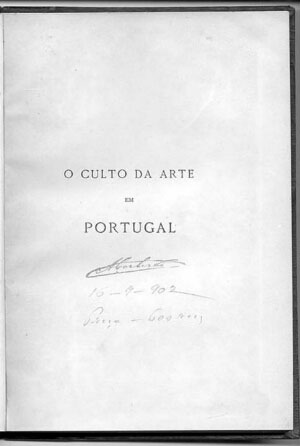
Among these opinions, one stood out concerning the Batalha Monastery and the restoration interventions carried out there. The document, initially technical, expanded into a much broader reflection on the condition of Portuguese art in contemporary times. In 1896, Ramalho published this work with the title The Cult of Art in Portugal, dedicating it to the Commission of National Monuments. The work would become the most important nineteenth-century manifesto in defense of heritage in Portugal, influencing generations of architects, historians, and conservators, and remaining relevant even during the Estado Novo, decades after the author's death.
The text of more than one hundred pages was not merely a diagnosis of the situation of Portuguese artistic and historical heritage—it was a cry of alarm. Ramalho denounced the "lamentable state of the arts in Portugal," the fruit of the indifference and ignorance of a modern nation incapable of preserving the works of its past. Influenced by a vast reading list—from Alexandre Herculano, Possidónio da Silva, and Gabriel Pereira in the Portuguese context, to Chateaubriand, Raczynski, Victor Hugo, Viollet-le-Duc, and Ruskin in the European—Ramalho proposed concrete solutions: systematic inventory of movable heritage with descriptive records, artistic education of the people, and the creation of a true History of Art in Portugal based on scientific foundations.
The ultimate objective was pedagogical: "Monuments and objects of national art are preserved only through the love of the people, once awakened to the consciousness and pride of itself." For Ramalho, the mission was clear: "to protect by teaching to love." Only through heritage education could "Tradition" be saved—that set of elements that constituted the true soul of the nation, and which today we simply call Heritage.
The Historical Context of the Publication
The publication of The Cult of Art in Portugal in 1896 did not emerge by chance. It was inscribed in a specific historical context, marked by the national trauma of the English Ultimatum of 1890. When Great Britain demanded that Portugal abandon its territories between Angola and Mozambique, the country found itself wounded in pride and confronted with its political and military fragility. The reaction was immediate: throughout the country, protests of redress were generated, from high dignitaries to local governments, in an outbreak of nationalism that encompassed all sectors of Portuguese society.
The crisis of 1890 accentuated existing political and social tensions and precipitated the progressive ruin of the constitutional monarchy, which proved impotent before the new course of events. The Republican party, growing since the 1870s, found in this juncture the crucial moment to deliver its message in favor of the "resurgence of a national identity." But the nationalist sentiment that then awakened was not only political—it was also, and above all, cultural.
The defense of heritage was, therefore, simultaneously scientific, aesthetic, and patriotic. It was necessary to save the monuments not only from physical ruin, but also from oblivion and decharacterization. And it was necessary, above all, to "educate the people" so that they would love what was theirs: "Monuments and objects of national art are preserved only through the love of the people, once awakened to the consciousness and pride of itself."
The Contemporary Relevance of Ramalho Ortigão's Message
The contemporaneity of this message is disturbing. More than a century after Ramalho's death, we continue to debate the same questions: how to preserve heritage without mummifying it? How to make it accessible without trivializing it? How to finance conservation in times of budgetary austerity? How to educate populations to recognize value in what they have inherited? How to prevent contemporary "restorations"—driven by tourist imperatives or misguided notions of "authenticity"—from repeating the errors that Ramalho denounced one hundred and thirty years ago? The Tomar window, classified by UNESCO as World Heritage in 1983, benefits today from legal protection and financial resources that Ramalho never imagined. And yet, the fundamental question remains: what do we do, as a society, with the memory we have inherited?