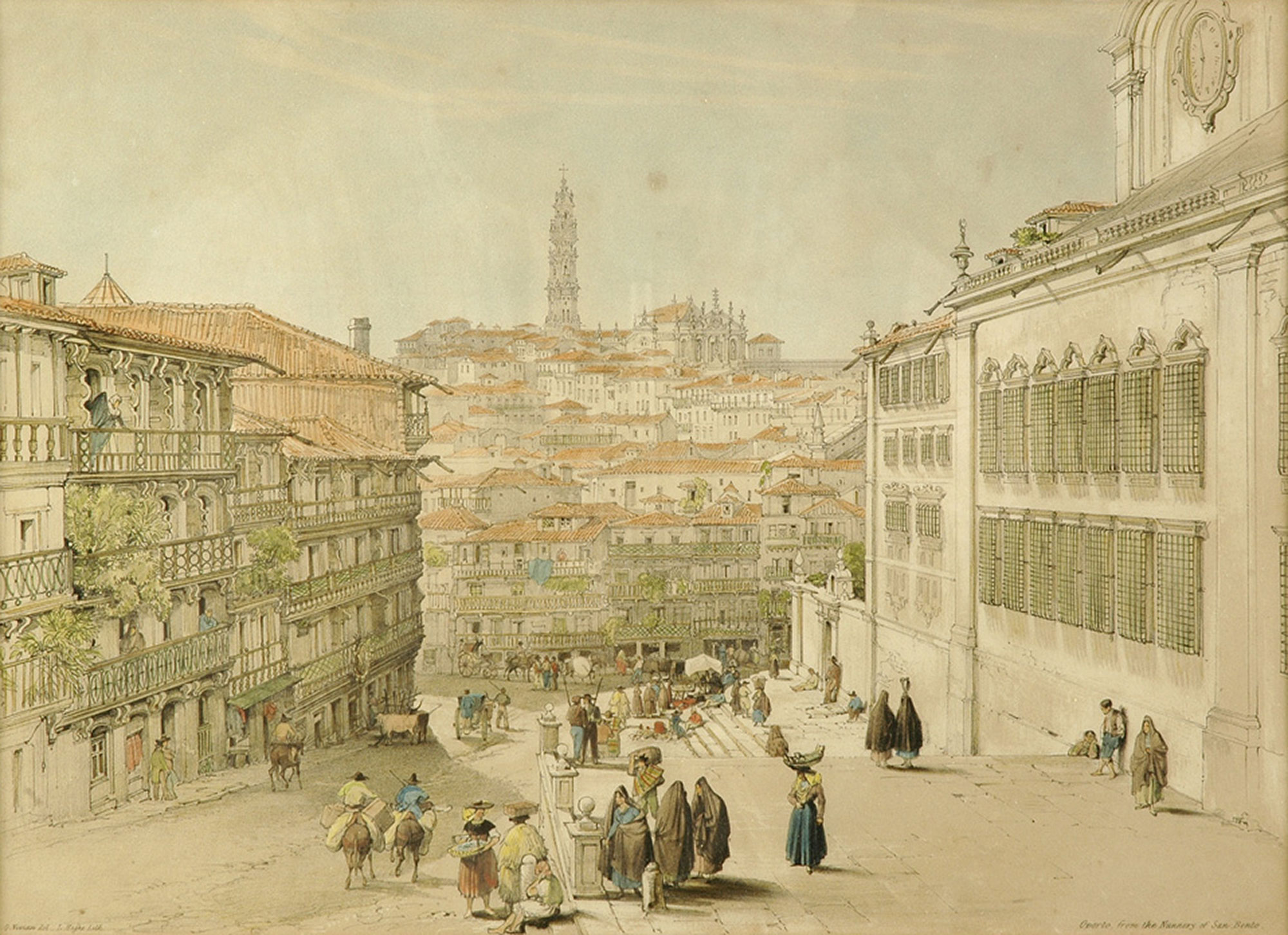
This tension between bourgeois conformism and literary audacity constitutes the fundamental axis of the vision that Ramalho left us of his native city. The Porto bourgeois — the enriched merchant, the Port wine trader, the urban landlord — was Ramalho's preferred target of satire. These merchants of Clérigos, Rua Nova dos Ingleses and Rua das Flores:
spoke to people, strutting behind their counters or their desks with the same imposing and majestic whitewash they would have in the curule chairs of the Porto council houses.
Figuras e Questões Literárias
The writer saw in them the incarnation of a conservative and provincial mentality, averse to new ideas and devoted to the routine of business and religious practices. It was this class that filled the processions, organized church festivals and kept traditional customs alive, such as the famous súcias — the evening gatherings in private homes where, as he wrote in Farpas I, marked quino was played with beans and a cup of lukewarm water was drunk, serving sugar and milk while a water dog, in silver, bristled with toothpicks stood out in the center of the pastry tray.
The entertainment of high society
The amusements of Porto's good society were relatively scarce but rigorously codified. In winter, there were the monthly concerts of the Philharmonic Society, on Rua da Fábrica, the gambling at the Porto Assembly, on Rua do Almada, the select balls of the English Factory, the latter reserved for the aristocratic British colony. In summer, families embarked in canopied boats to Oliveira, to Avintes or to Quebrantões, taking with them all the paraphernalia of Sunday gastronomy.
Ramalho painted these scenes with intense colors:
The master, in denim fortnightly and straw hat; the daughters ahead, in muslin toilette; the wife beside, in nobility skirt, cotton thread gloves and the rabbit mantilla on her arm; the maid with the new peasant clothes from Maia; and the shop boy behind with the basket of provisions.
As Farpas I
And at nightfall they returned by the river, while the echo of Serra do Pilar repeated like a sob, from the other side, a plaintive violin arpeggio or a nostalgic strumming of guitars.
In violent contrast with this placid bourgeoisie stood out the literary generation that gathered at Guichard's bookstore, at the Moré door and at the Águia de Ouro. Ramalho evoked with admiration and nostalgia those times when Camilo Castelo Branco stirred the city with his biting feuilletons and his romantic exploits. For these literary dandies,
the only common enemy was human stupidity, represented by the honest bourgeois of Rua das Flores and Rua dos Ingleses, and it was the immobilizing spirit of routine, symbolized in the carroção family vehicle pulled by oxen and invented by the harness maker Manuel José de Oliveira.
As Farpas I
At the São João theater
The São João Theatre was one of the main focal points of Porto's cultural life. The great Italian opera companies paraded through there, filling Portuguese stages with their vigorous dramatic talent. The Academy of Fine Arts, although the target of Ramalho's criticisms regarding its competition programs, represented another pole of artistic activity. The writer closely followed these cultural manifestations in his feuilletons for Jornal do Porto, where he distinguished himself as a theatre and art critic, already demonstrating that independence and sagacity that would characterize all his future work.
Chronicle of a royal visit
Royal visits awakened in Porto's bourgeoisie a monarchical fervor that Ramalho described with amused benevolence. When the Royal Family visited the city:
a broad resonance of fair enveloped the Clérigos Tower. The entire city, like a single dandy, ordered tailcoats made... Rua das Flores en masse, Largo da Feira and both Ferrarias, the Upper and the Lower, dressed in court fashion.
As Farpas XI
Triumphal arches were erected, tableware was lent for banquets at the Crystal Palace, and large gilded cardboard keys were offered, symbolizing the keys to the city. This fervent monarchism of bourgeois Porto contrasted ironically with the presence, posted at the Moré door, of the one whom the Farpas called the asp of the Monarchy — the republican poet Gomes Leal, to whom Ramalho nonetheless recognized elevated artistic talent.
A political vision in mutation
Ramalho Ortigão's own political positioning evolved throughout his life. Although initially close to the liberal and progressive ideas of the Generation of '70, the writer became increasingly critical of the direction the country was taking. The establishment of the Republic in 1910 represented an unacceptable rupture for him. With the death of King Carlos and the crown prince in 1908, and especially after the republican revolution, Ramalho self-exiled in France, only returning some years later to Portugal, where he would die in September 1915, in his house in Lisbon.
A divided city
The portrait that Ramalho Ortigão left us of nineteenth-century Porto society remains an irreplaceable document. In it we find a meticulous description of customs and social types. But there is also no lack of a profound reflection on the contradictions of a city divided between tradition and modernity, between comfortable provincialism and intellectual restlessness.
Ramalho was a witness to that era when Porto, still maintaining that good and healthy provincial smell, was already beginning to lose its distinctive identity, transforming into the commercial city, civilly cosmopolitan, uncharacteristic and banal that he would deplore in his later writings.