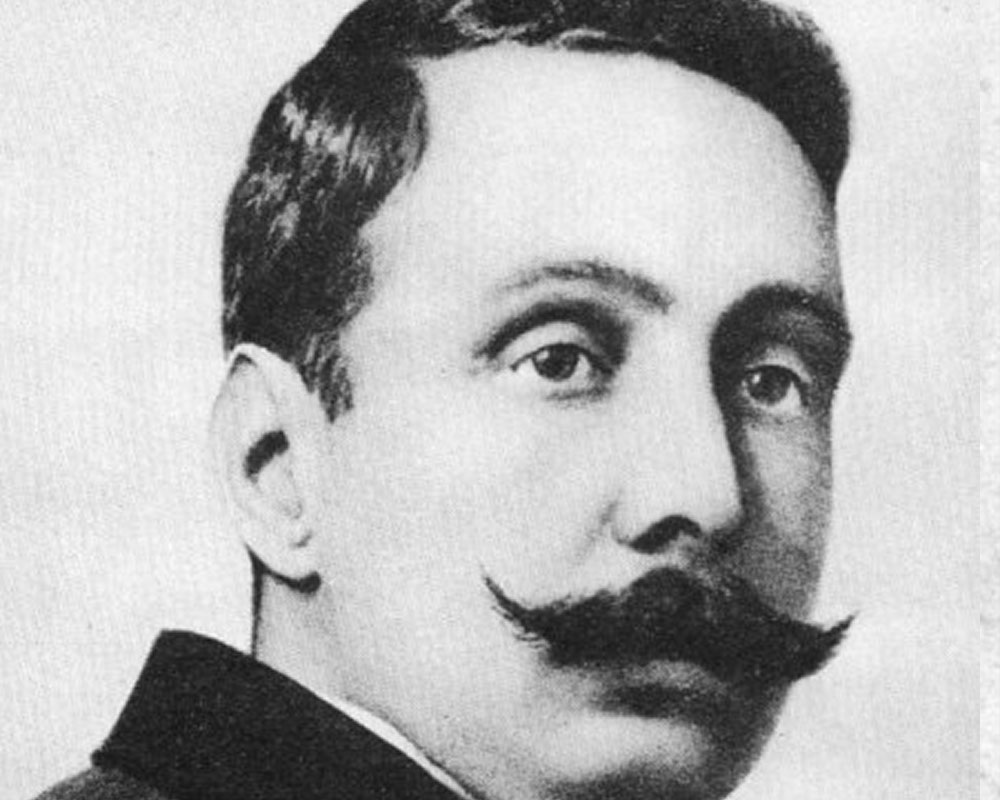
Raul Germano Brandão grew up breathing the sea breeze and living among the people of the sea – a childhood that would forever mark his artistic and human vision.
Between the Sea and Letters
Son of small landowners and descendant of a lineage of men connected to the ocean, young Raul absorbed from an early age the harshness and poetry of fishing life. The physical and human landscape of that Porto area shaped his sensibility, preparing the ground for a literary work profoundly marked by the "offended and humiliated" of Portuguese society.
In Porto, he attended Colégio São Carlos, where in 1885 he participated in a notable solidarity initiative: the creation of the school magazine "O Andaluz", intended to raise funds for the victims of earthquakes in Andalusia. Among his colleagues in this publication were future prominent names such as João de Lemos, José Leite de Vasconcelos, and Trindade Coelho.
The Years of Formation and First Revolts
His academic path took him to the Polytechnic Academy of Porto, where he became acquainted with young people who, like him, dreamed of renewing Portuguese literature. Among these were António Nobre – who would become the poet of "Só" – and Justino de Montalvão. This intellectual camaraderie culminated, in 1892, in the subscription of the "Nefelibatas" manifesto (Greek term designating "those who walk in the clouds," that is, the dreamers), a cry of rebellion against the literary establishment.
Curiously, despite having attended higher education in Letters, Raul would end up pursuing a military career. In 1888, perhaps to satisfy his parents or due to the inevitability of the recruitment law, he entered the Army School in Lisbon. The following year, he participated in the formation of the group "Os Insubmissos" and the homonymous magazine, which he himself coordinated – a title that perfectly symbolized his rebellious spirit.
Literary Debut and Journalistic Fervor
Barely out of adolescence, in 1890, he published his first work: "Impressões e Paisagens", a collection of naturalist short stories that revealed an attentive observer of social realities. From then on, he plunged into the literary renewal movements of the time. In 1895, together with Júlio Brandão and D. João de Castro, he directed the "Revista de Hoje", simultaneously beginning a vigorous journalistic career at "Correio da Manhã".
Journalism would become a constant in his life. He collaborated in publications such as "Imparcial", "Correio da Noite", and "O Dia", where he did not shy away from delving into the darkest themes: human suffering, existential anguish, the mystery of death. These reflections, far from being mere intellectual exercise, were born from genuine compassion for society's marginalized.
Guimarães, Love, and the Casa do Alto
In 1896, having completed his military training at the Practical School of Infantry in Mafra, he was stationed as a second lieutenant in Infantry Regiment No. 20, in Guimarães – the so-called "cradle city" of Portugal. It was there that he met Maria Angelina, the woman he would marry in March 1897 and who would become his lifelong companion, including in writing (they would later collaborate on "Portugal Pequenino", a children's narrative from 1930).
After a year in Guimarães, the couple transferred to Porto, returning to his native Foz. However, in 1901, Raul requested a new posting, this time in Lisbon, where he approached intellectual and even anarchist circles, intensifying his journalistic activity.
Life would be divided, from then on, between two poles: Lisbon, effervescent and cosmopolitan, and the Casa do Alto – a farm in Nespereira, near Guimarães, which he had acquired in 1903. In this northern retreat, Raul not only wrote but also managed the property, dealing directly with the rural world. This contact awakened in him feelings of profound compassion for the hardships of agricultural communities, a theme that would become central to his literature.
The Literary Revolution: When the Novel Ceases to Be a Novel
Between 1902 and 1903, while alternating between rural isolation and the capital, Raul began working on a work that would challenge all conventions of the novelistic genre: "Os Pobres", published in 1906. This book inaugurated a problem of conscience that would torment him: sympathy for the exploited coexisting with the egoism inherent to his condition as a small-bourgeois landowner.
But it would be "Húmus", published in 1917 and dedicated to his painter friend Columbano (who had made two portraits of him and would later paint the couple), that would consolidate his literary revolution. This work, hardly classifiable as a traditional novel, approached poetic and philosophical writing, calling into question conventional modes of representing reality.
Influenced by Dostoevsky, by symbolism, and by a modernist sense avant la lettre, Raul fragmented the concept of narrator: the "I" debated with an alter-ego, the philosopher Gabiru, whose voice emerged in the "papéis do Gabiru". The narrative broke with temporal and syntactic linearity, developing circularly around obsessive symbols: tree, dream, pain, amazement, death.
Before "Os Pobres", Raul had written "A Farsa", a pioneering novel where he gave voice to Candidinha, a marginalized being who, under the appearance of submission, condensed a corrosive discourse of hatred, envy, and malice – a character that anticipated the modernist interest in peripheral and subversive voices.
The Historian of Convulsions
Between the publication of "Os Pobres" and "Húmus", Raul dedicated himself to historical novels that recreated the convulsions of early nineteenth-century Portugal: "El-Rei Junot" (1912), "A Conspiração de 1817" (1914, reissued in 1917 as "1817 - A Conspiração de Gomes Freire"), and "O Cerco do Porto" (1915), the latter attributed to English colonel Hugo Owen, with Raul having annotated and prefaced the work.
Although they required rigor in the treatment of historical material, these works did not abandon his metaphysical obsession. As he wrote in the introduction to "El-Rei Junot": "A história é dor, a verdadeira história é a dos gritos. [...] O Homem tem atrás de si uma infindável cadeia de mortos a impeli-lo, e todos os gritos que se soltaram no mundo desde tempos imemoriais se lhe repercutem na alma."
Memories of an Inner Life
He published three volumes of "Memórias" (1923, 1925, and 1933), where he evoked episodes, figures, rumors, and political and social jokes, offering direct testimony about historical events. But even in this supposedly factual genre, the boundary with fiction dissolved. In the preface to the first volume, he stated: "O Homem é tanto melhor quanto maior quinhão de sonho lhe coube em sorte. De dor também."
The memoirs revealed a man who detested external action, preferring contemplation: "De dia podo as minhas árvores, à noite, sonho. Sinto Deus - toco-o." For Raul, the great existential problems were not solved by philosophers, but "pelos pobres vivendo".
The Theater of Subversion
In parallel, he produced several theatrical plays that subverted the dramatic expectations of the time: "O Gebo e a Sombra" (performed in 1927 at the Teatro Nacional), "O Doido e a Morte" (staged in 1926 at the Teatro Politeama), "O Rei Imaginário", "Eu Sou um Homem de Bem", and "O Avejão" (1929). Back in 1899, in partnership with Júlio Brandão, he had written "Noite de Natal", performed at Teatro D. Maria.
In 1923, he compiled some of these works in the book "Teatro". He planned to publish four volumes of theatrical work, but the project would remain incomplete.
Crises, Travels, and New Projects
In 1906, he traveled through Europe with his wife – an experience that broadened horizons. However, around 1910, he suffered a crisis of nervous depression, perhaps a reflection of the intensity with which he lived the contradictions of existence. In 1911, he ended his military career, retiring with the rank of major the following year.
With more available time, he conceived ambitious projects. He planned to write a "História Humilde do Povo Português", of which "Os Pescadores" would be the first volume, followed by "Os Lavradores", "Os Pastores", and "Os Operários" – never realized. In 1924, he traveled to the Azores and Madeira, an experience that resulted in "As Ilhas Desconhecidas" (1926).
Seara Nova and the Final Years
From 1921 onward, Raul spent winters in Lisbon, socializing with the founding group of the magazine "Seara Nova" – an intellectual movement that brought together names such as Jaime Cortesão, Raul Proença, and Aquilino Ribeiro. This generation recognized him as a tutelary figure, alongside Fernando Pessoa, in the evolution of twentieth-century Portuguese literature.
In 1927, he published "Jesus Cristo" in collaboration with Teixeira de Pascoaes, a poet with whom he shared mystical affinities. That same year, Columbano painted the portrait of the couple Raul and Angelina Brandão. Death interrupted his plans. Raul Brandão died in Lisbon on December 5, 1930, at sixty-three years of age. The following year, "O Pobre de Pedir" appeared posthumously.
An Indelible Legacy
The rediscovery of Raul Brandão's work would serve as a path for later generations to reformulate traditional novelistic structures. His meditation on the metaphysics of pain and the absurdity of the human condition, expressed in a language that broke with conventional narrative linearity, anticipated by decades the experiments of the modern novel.
Today, the street in Foz where he was born bears his name, and a monument in the Jardim do Passeio Alegre honors the man who, between the sea and the northern farm, between combative journalism and philosophical contemplation, bequeathed us one of the most singular and disturbing works of Portuguese literature.