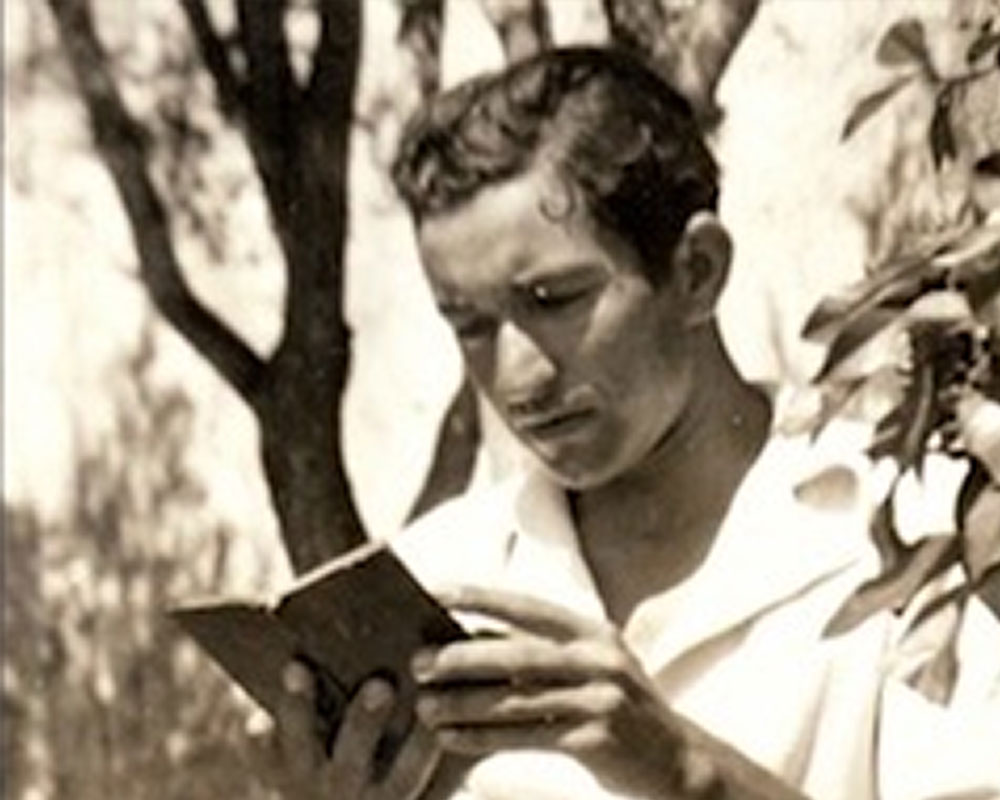
The Green Refuge That Became a Muse
Health problems arose early. By medical recommendation, young Sebastião was sent to breathe the clean air of Serra da Arrábida, in the municipality of Setúbal. What could have been merely a treatment became a love story. Enveloped by all possible gradations of green, with the Atlantic peeking between the hills, Sebastião discovered his earthly paradise.
That landscape was not merely beautiful – it was sacred.
And when it began to be threatened by blind progress, when the asphalt of modern roads began to tear through the slopes he venerated, the poet refused to remain silent. In August 1947, he wrote a passionate letter addressed to various personalities, clamoring for the protection of Serra da Arrábida. This missive would become the embryo of the League for the Protection of Nature, founded the following year – the first Portuguese environmental association. Sebastião da Gama was, long before the term became popular, an authentic pioneering ecologist.
From Philology to the Classroom
He enrolled in the Faculty of Letters at the University of Lisbon, opting for Romance Philology – scientific study of languages derived from Latin, including Portuguese. He completed his degree in 1947, at which time he competed for a teaching position in technical education (equivalent to current vocational education).
His first teaching experience took place at the Industrial and Commercial School Veiga Beirão, in Lisbon, where he completed his internship as a Portuguese teacher. Those months proved to be an epiphany. Sebastião discovered that teaching was not mechanically transmitting subject matter – it was establishing human bridges, creating complicity. He defended a revolutionary proximity between student and teacher, summarizing his philosophy in a phrase that would become famous: "ensinar é amar". This pedagogical experience was meticulously recorded in a text that would be published posthumously in 1958, under the title "Diário".
It was not a vulgar chronological account, but rather a profound reflection on the act of educating. The book marked entire generations of Portuguese teachers and continues to be a mandatory reference, currently in its thirteenth edition – eloquent proof of its timeless relevance. After the internship, he taught in Setúbal, at the Industrial and Commercial School (today Sebastião da Gama Secondary School, named in his honor), and later in Estremoz, at the local commercial and industrial school. Also in this Alentejo city his name would endure, associated with the current Sebastião da Gama Basic School.
The Poetic Voice That Sang to Nature
While teaching and fighting against the disease that undermined his body – renal tuberculosis, which had accompanied him since adolescence –, Sebastião wrote. And he wrote with an intensity that only those who sense the end know how to imprint on words. His literary debut occurred in 1945 with "Serra-Mãe", a passionate hymn to the Arrábida that had sheltered him. The book, like two other works of his, was illustrated with vignettes by his painter friend Lino António, creating a perfect symbiosis between word and image. The following year, 1946, he published "Loas a Nossa Senhora da Arrábida" in partnership with Miguel Celeiro – "loas" being an archaic term meaning hymns of praise or celebration. These were followed by "Cabo da Boa Esperança" (1949) and "Campo Aberto" (1951), works that revealed a profoundly original author, for whom nature was not mere scenery, but divine presence. In parallel, he collaborated in periodical publications such as "Mundo Literário" (between 1946 and 1948), "Árvore" and "Távola Redonda", disseminating his poetic vision among the literary circles of the time.
The Premature End and the Imperishable Legacy
Renal tuberculosis showed no mercy. On February 7, 1952, in Lisbon, Sebastião da Gama died at only twenty-seven years old, just months away from completing his twenty-eighth birthday. He left a vast and coherent work, imbued with a spirituality that privileged the relationship with the divine through contemplation of nature. Death did not silence his voice. In 1953, "Pelo Sonho é Que Vamos" appeared – a title that would become one of the most quoted mottos of Portuguese literature, an expression of hope and idealism. This work had a second edition in 1971, with a preface by the poet Ruy Belo.
In 1958, the Journal of the Faculty of Letters of Lisbon published as a separate offprint "Lugar de Bocage na Nossa Poesia de Amor", the result of conferences that Sebastião had given about the eighteenth-century poet Manuel Maria Barbosa du Bocage. In 1967, David Mourão-Ferreira compiled and prefaced "Itinerário Paralelo", gathering scattered texts. The pedagogical "Diário", published in that same year of 1958, consolidated his reputation as an education thinker, transforming him into a reference for successive generations of teachers who sought to humanize teaching.
Late but Well-Deserved Recognition
Decades after his death, the Portuguese State formally recognized Sebastião da Gama's contribution. On June 9, 1993, he was posthumously awarded the rank of Grand Cross of the Order of Infante D. Henrique – one of the highest national decorations, reserved for those who render relevant services to the Portuguese cause.