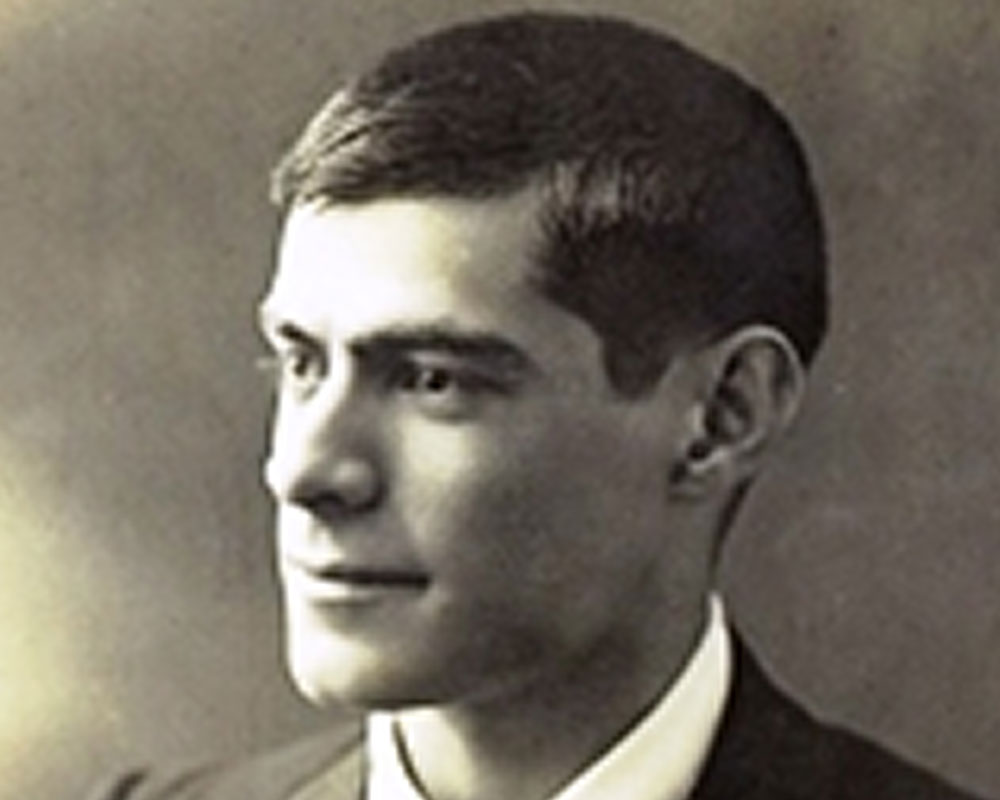
Described by many as possessing supernatural powers, this voluntary hermit attracted pilgrimages of intellectuals from all over Europe. His true name was Joaquim Pereira Teixeira de Vasconcelos, but the world would know him as Teixeira de Pascoaes.
Aristocratic Roots and a Childhood of Solitude
Born on November 8, 1877 in the parish of São Gonçalo, in Amarante, he was the second of seven children of João Pereira Teixeira de Vasconcelos – judge, deputy to the Courts and wealthy farmer of notable culture – and Carlota Guedes Monteiro. The family belonged to the rural aristocracy with deep roots in that northern region.
From childhood he proved different from his siblings. While one of them, João, would leave for Africa and write "Memórias Dum Caçador de Elefantes", little Joaquim was "cabisbaixo, sisudo, com uns olhos tristes e espantados" – as he himself would describe himself. The universe of his childhood was reduced to "um pobre campanário de pedra, cercado de três casebres e oliveiras, com um sino sentimental que chora todas as tardes e por todos os que morrem".
He was a solitary, introverted child, immersed in a nostalgic contemplation of Nature that would become the keynote of his entire existence.
The Monastic Student of Coimbra
In 1883, at six years old, he began primary studies in Amarante. Four years later, in 1887, he entered the Lyceum of the same town – and was not a brilliant student, even failing Portuguese, an ironic fate for someone who would come to be considered one of the greatest poets of the language. Before leaving for Coimbra, he had already published in Porto, in 1895, his first book: "Embriões". That year he moved to the university city to complete secondary studies and, in 1896, enrolled in the Law course at the University of Coimbra.
Contradicting the bohemian tradition of Coimbra students, Pascoaes lived monastically, confined to his room, devoted to books, papers, and the ruminations of one who "não fora feito para este mundo". During the academic period, he published "Bello" (two parts, in 1896 and 1897), "Sempre" (1898), and "Terra Proibida" (1899) – works that already presaged the lyrical somnambulism, the detachment from other men, and the religious feeling of things that would make his poetry unmistakable.
He graduated in 1901, but his heart "apenas palpitava pela virgem que nunca existiu e de que tinha saudades, vaga aspiração de azul e de inocência". Pascoaes' true love was directed toward nature, silence, mystery, ghosts.
The Duel Between the Poet and the Jurist
Reluctantly, he established himself as a lawyer, first in Amarante and, from 1906, in Porto. In 1911, he accepted the appointment as substitute judge in Amarante, a position he held for two years. In 1913, with visible relief, he definitively closed his judicial career.
About this painful decade, he would later say: "Eu era um Dr. Joaquim na boca de toda a gente. Precisava de honrar o título. Entre o poeta natural e o bacharel à força, ia começar um duelo que durou dez anos, tanto como o cerco de Tróia e a formatura de João de Deus."
He was a wealthy landowner and did not need to work to support himself. He then settled in the family manor in Gatão, with his mother and other family members, dedicating himself to land management, reading, writing, and, above all, the tireless contemplation of Serra do Marão.
The Prophet of Saudosismo
With António Sérgio and Raul Proença, he led the Portuguese Renaissance movement, launching in 1910, in Porto, together with Leonardo Coimbra and Jaime Cortesão, the magazine "A Águia" – the main organ of the movement. Between 1912 and 1916, he directed this publication, where he disseminated his philosophy of saudosismo.
For Pascoaes, Saudade was not mere sentiment of nostalgia – it was the very universal ontological condition (that is, relating to the nature of being) of all existence. He argued that saudade permeated both the human being and nature and even God himself, in a pantheist vision (which sees the divine present in all nature) where God inhabits creation to redeem a fall inherent to the divine itself.
He intended to establish saudade as "expressão superior da alma portuguesa", in its two aspects: memory and desire. Works such as "A Arte de Ser Português" (1915) and "Os Poetas Lusíadas" (1919) consolidated this thought, making him one of the most important contemporary thinkers of Portugueseness.
The Hermit Who Received the World
Despite his solitary life, Gatão became a place of pilgrimage. Intellectuals and artists, national and foreign, visited him frequently, attracted by his lunar and phantasmagoric presence, by his "silenciosa atalaia planetária".
He maintained a profound epistolary friendship with Frei Bernardo de Vasconcelos, a young Benedictine monk who was his relative. They never met personally, but Pascoaes would say in a letter to his sister that Frei Bernardo was "o maior e mais perfeito amigo que Deus me concedeu".
In 1918, he gave a lecture in Barcelona alongside Eugenio d'Ors. In 1923, he visited the prestigious Residencia de Estudiantes in Madrid, achieving notoriety among writers such as García Lorca, with whom he exchanged postcards and dedicated books. He cultivated deep friendship with Miguel de Unamuno and with Lusophiles such as Ignasi de Ribera i Rovira and Fernando Maristany y Guasch, who translated and widely disseminated his poetry in Spain in the twenties.
Galicia embraced him as its own poet. Vicente Risco would affirm, after his death, that "a Galiza o pranteou como se fosse dela", recognizing his merit in revealing Galician saudade. A street in A Coruña bears his name today.
The Difficult Relationship with Pessoa
Fernando Pessoa defined him as "um dos maiores poetas vivos e o maior poeta lírico da Europa de hoje". However, Pascoaes distrusted Pessoa, considering him "pouco ou nada poeta". The latter reciprocated the hostility, accusing him of "sofrer de pouca arte" and rendering him only "uma correcta deferência fria como a veneração devida aos grandes deuses mortos".
Despite the poetic voices of Junqueiro and António Nobre (whom Pascoaes, ironically, considered "a nossa maior poetisa"), he differed from them by constructing "frases mais amplas, mais repousadas, ao sabor clássico", being "quase sempre simples e directo, moderado nas metáforas", seeming "anterior aos simbolistas pela claridade e pureza das formas".
Recognition and Final Years
In 1923, he was elected to the Academy of Sciences of Lisbon. In 1951, he received homage from the Academy of Coimbra. His poetry was translated into several languages and praised by distinguished peers. In the final years of his life, he befriended younger poets such as Eugénio de Andrade and Mário Cesariny de Vasconcelos. The latter would elect him as a poet superior to Fernando Pessoa, organizing in the 70s and 80s the reissue of various texts and a poetic anthology.
Miguel Torga, his younger literary "irmão", would define him thus: "Teixeira de Pascoaes é o trágico aedo existencial da nossa condição de exilados da realidade, de encobertos no descoberto, de perseguidores de imagens."
The End of a Mystic
He died on December 14, 1952, at seventy-five years of age, in Gatão, victim of pulmonary bacillosis (tuberculosis in the lungs), some months after his mother's death. The body rests in a tomb in the cemetery in front of the Church of São João Baptista de Gatão.
The grave is flat and bears inscribed verses that the author himself purposefully wrote to appear there, perfect synthesis of an existence that was consumed in contemplation and word: "Apagado de tanta luz que deu Frio de tanto calor que derramou"
For the curious traveler: When visiting Amarante and the surrounding villages, seek out the Gatão manor where Pascoaes lived for decades. Serra do Marão continues there, imposing and lunar, silent witness to the contemplations of a poet who tried to express the inexpressible. According to Domingos Monteiro, Pascoaes' poetry is "a mais bela tentativa de expressão do inexprimível que nos últimos dois séculos se realizou em Portugal". The cemetery where he rests, in front of the small church of Gatão, is a place of serenity and discreet beauty – a worthy end for one who made saudade not merely a literary theme, but a philosophy of life.