Article
Article
The Tomar Window Under Ramalho Ortigão's Magnifying Glass
The famous window of the Chapter Room opens in the eastern façade of the Convent of Christ, facing east, in an arrangement that is not accidental: the morning light bathes the carved stone, progressively revealing the depth of its reliefs and the complexity of the decorative program. It is a twin opening with ogival arches, framed by a gigantic arch that functions as an architectural frame for the entire ensemble.
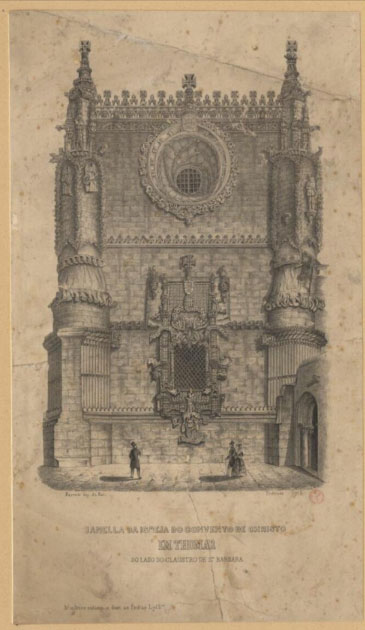
It is upon this framework that Diogo de Arruda will deposit an ornamental universe that challenges many of the stylistic conventions of the era.
From a technical standpoint, the window measures approximately six meters in height and is supported by two central columns that function simultaneously as structural elements and as symbolic support for the entire decorative discourse. It is here that Ramalho Ortigão begins his reading of the monument, recognizing in those columns much more than mere stone shafts. They are, in his eyes, "coral polyp formations from the deepest ocean reefs, and trunks of that palm tree whose shade covered the cradle of civilization on the Mediterranean coast."
The description is not a vague metaphor. Ramalho identifies with precision the motifs carved in the limestone, recognizing the coralline formations that Portuguese navigators would have observed in the ocean depths off the African and Indian coasts, as well as palm trunks stylized according to Oriental iconography that crusaders and pilgrims had brought from the Holy Land.
The Corals
are today seen as formations of unparalleled biodiversity, whose threat reveals the growing destruction of the oceans and life on the planet. At the time, they certainly represented the unfathomable depth and abyss of the seas traversed by Portuguese ships. In fact, in Antiquity, the Roman historian Pliny the Elder (Book XXXII of Natural History) describes the belief of Indian seers in the virtues of corals as amulets to ward off all kinds of dangers. But we can also find examples of coral rosaries and amulets in Renaissance painting itself, the latter in necklaces intended to protect young children.
For Ramalho, those coral reliefs in the form of organic ramifications evoke the "wealth of discovered reefs," the biodiversity of tropical seas that the Portuguese began to chart. But here there is also, as we saw earlier, a theological dimension: coral, in medieval and Renaissance symbolism, was considered a protective stone, a talisman against evil, a substance simultaneously mineral and vegetable that sprouted in aquatic depths as trees sprouted from the earth.
The Palm Trees,
in turn, introduce a symbolic genealogy that goes back to the origins of Christianity. Ramalho recognizes in the palm tree "the holy tree, the tree of the Bible, the tree of Jesus, whose symbolic branch is an attribute of passion and Easter, of glory and martyrdom." The palm tree that gave shade to pilgrims in desert oases, to which the Arabs of the Peninsula dedicated a spring festival "based on the dissemination of pollen," appears here as a bridge between three religious and cultural universes: primitive Christianity of the eastern Mediterranean, the peninsular Islam that the Portuguese knew so well, and the new tropical world that was opening to maritime expansion.
The Ocean Waves
unfold "just as they are represented in heraldry," Ramalho recalls. They are not naturalistic waves, but codified stylizations according to the grammar of medieval heraldry, those waves that symbolized nautical dominion in the coats of arms of noble houses most connected to the sea. Their presence in Tomar establishes the Atlantic as a heraldic space, a territory capable of being inscribed in symbolic language. From the author's perspective, the sea ceases to be a chaotic element to become a field of civilizational action, a surface upon which one can write and govern.
The Cork Oaks
burst into the composition with the force of one who never left native soil. Ramalho sees in them the "secular trunks and deep roots of the cork oaks of our hills, extreme expression of strength in the fecundity of sap, which binds the oak, just as tradition and family bind the weak and wandering human creature, to the heart of the land where it was born." They are the counterpoint to the sea: while the waves represent mobility, adventure, the cork oaks symbolize fixation, permanence, rootedness in the Portuguese landscape.
One should not forget that it is the cork extracted from these trunks that will serve precisely to manufacture the buoys that float in fishermen's nets—a material synthesis between land and sea, between permanence and movement. Ramalho understands that the window stages a dialectic between two poles of national identity: the centrifugal impulse of expansion and the centripetal force of tradition.
The Alentejo Bells
introduce an unexpectedly rural note into a decorative program consecrated to seas and navigation. Ramalho identifies them with precision: "like those of draft mules harnessed to the Alentejo cart, twisted rods of cork oak and holm oak become entangled, as in the lictor's bundles of Roman magistracy." The comparison with Roman fasces is not innocent: the bells, instruments of daily agricultural life, are elevated to the dignity of symbols of authority, equated with the emblems of Roman consular power.
Diogo de Arruda reminds us here that the Portuguese empire is built not only with caravels and trading posts, but also with the work of the land, with the cereal culture of Alentejo, with peasant life that sustains the logistical rearguard of expansion, recalling that the entire maritime epic depends on agricultural production that feeds the sailors and finances the fleets.
The Chains and Nautical Cables
function as elements of structural and symbolic articulation. "Solid chains and powerful deck cables, from which cork buoys hang in discs, entwine the decoration, vigorously mooring it to the gable by strong rings, as one would moor a ship to a port quay," writes Ramalho in one of the most celebrated passages of his description. The window transforms into a vessel, the building into a port, the façade into a quay where the ship of empire is moored. The chains are not mere ornaments: they fulfill a compositional function, unifying the various decorative elements into a coherent whole, preventing the ornamental profusion from dispersing into chaos.
At the Top of the Composition,
"the entire composition, departing from the shoulders of a man who seems to sustain its entire weight, ascends in a trembling of algae and foliage to the Cross of Christ among the spheres that the fortunate king of triumphant Portugal had taken as his emblem across the vastness of the seas, throughout the entire circuit of the globe." The anthropomorphic figure at the base carries on its shoulders the entire symbolic weight of the empire.
The Cross of Christ and the Armillary Spheres
emerge as the natural culmination of the entire ornamental ascension: the cross, emblem of the Order that financed maritime expansion, and the armillary sphere, personal device of King Manuel, astronomical instrument that allowed calculation of latitudes and that had become a symbol of the ambition to dominate "the entire circuit of the globe." Ramalho recognizes here the synthesis of the Manueline enterprise: evangelization and navigation, faith and science, crusade and commerce, indissolubly intertwined.
Finally, the Rose-Sail
crowns the ensemble in an image of poetic audacity. Ramalho describes it as "the majestic rose window of the temple, formed in a circle by the folds and the heaving bulge of the furled sail of an India galleon." The traditional Gothic rose window, liturgical element par excellence, transmutes into a nautical sail, into canvas that fills with wind, into the propelling element of the ship. The religious building assumes itself as a machine of expansion, as an instrument of spiritual and temporal conquest. The light that passes through that rose-sail is not only the divine light of medieval theology; it is also the light of the tropics, the sun of equatorial latitudes, the brightness of new worlds that open to Christianization.
Ramalho Ortigão understood that this window does not illustrate the empire: it is the empire, condensed in stone. Each decorative element functions as an ideogram of an aspect of Portuguese expansion, and the ensemble articulates itself in a "glorious harmony of full-voiced antiphon," a celebration in stone of the moment when Portugal imagined itself to the measure of the world.