Article
Article
The Tower of the Gourds - Chronicle of a Survival
In 1785, when Queen Maria I announced her visit to Santarém, the Scalabitan councilors faced a problem of geometry and protocol: the royal coach would have to pass between the Tower of Alporão and the Tower of the Gourds, and the space was manifestly insufficient.
The Viscount of Vila Nova da Cerveira, secretary of state, had sent from Salvaterra de Magos the exact measurements of the royal berlin. When the gauge was applied to the narrow passage, it was found that a "palm or palm and a half" was lacking—enough for the wheel hubs to become stuck between the two monuments.
The aldermen's solution was expeditious: they demolished the Tower of Alporão, witness to Roman dominion, a viewpoint from which the Arab had dictated to the people the law of Mohammed during the Saracen occupation. The queen passed. The tower disappeared. Santarém became poorer in memory.
More than a century later, in 1896, history threatened to repeat itself. A Technical Commission appointed by the Council now proposed the demolition of the Tower of the Gourds—not to give passage to a sovereign, but to the councilors themselves. It was then that Ramalho Ortigão, already in his sixties and a veteran in battles for heritage preservation, took up his pen in defense of that "simple square masonry piece" which, paradoxically, represented much more than its apparent architectural modesty suggested.
The Tower and the Legend
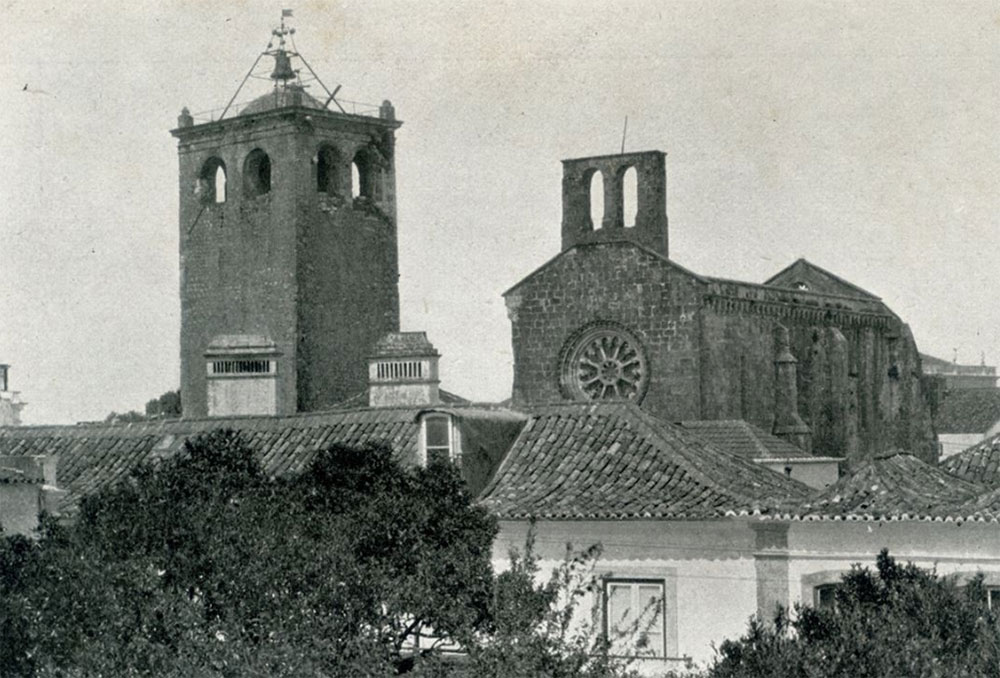
The name "Tower of the Gourds" comes from the singular structure that crowns it: four iron rods, obliquely braced at the four corners of the tower, converge at the top to support an exposed bell, and are covered with clay jugs from the local pottery—gourds intended to amplify the sonority of the bronze in the ringing of the hours and alarm signals.
Popular memory, however, prefers a more irreverent explanation: the gourds would represent the "hollow heads" of the councilors who decided to erect such an unappealing fortified mass.
Popular irony is not devoid of foundation. The tower's apparent ugliness stems mainly from the successive alterations to which the adjacent walls and bodies located at its base were subjected, granting the ensemble a vision of volumetric imbalance.
Nevertheless, historiography diverges regarding its origin: some attribute the primitive construction to the reign of King Manuel I, others point to an earlier dating, confirmed by the vestiges of walls to the north and by signs of different apparatuses above the initial construction. What is certain is that the tower was the object of works during the Manueline and Johannine reigns, and underwent documented interventions in 1604, under Philip II of Portugal.
The Aesthetics of Improvisation
Ramalho Ortigão understood what the "conspicuous bourgeois of the Santarém senate" could not understand: the Tower of the Gourds was not built to be contemplated from the council chambers, "in top hats, Sunday frock coats and shaved beards." It was made to be looked at "from the vast plain of Golegã or the plain of Almeirim, coming from Vale, coming from Coruche, from Benavente, or from Barquinha, through the olive groves, the sowing lands and the threshing floors of the Santarém district, in a jacket and wooden shoes, riding a foreman's mare."
The writer recognized in that "bell window, which seems mounted on four poles," an authentic work of art—not for its monumentality or nobility of materials, but for its capacity to evoke "the Arab origin, the nomadic life, the pastoral tradition of the region in which it arose." Its "strange finish" conferred upon it a truly "special, unmistakable, indelible" feature, making it "the most suggestive, the most anecdotal, the most interesting, the most affectionate, the most familiar, the most beautiful bell tower of all that very beautiful Ribatejo countryside, the most open agrarian smile of the Portuguese land."
Ortigão argued that there was "no plausible reason why, as an ornamental motif of a tower, our beautiful little red clay jug from Reguengo, Atalaia or Asseiceira should be preferred over the acanthus leaf or the volute tendril of Greek architecture." The defense of the tower was, fundamentally, the defense of an autochthonous aesthetic, rooted in the material culture of Ribatejo, against subservience to imported classical canons.
The Popular Outcry and Classification
The 1896 demolition proposal unleashed a vast wave of popular indignation in favor of preserving the tower. Ramalho sarcastically compared the situation: "That under the old regime the councilors of Santarém tore down the Tower of Alporão, for a queen to pass, is an extremely regrettable misfortune, but that under the current regime the Tower of the Gourds should equally be torn down, for the councilors themselves to pass, is a great decline in public administration to much worse than we were in the time of the much-missed lady Queen Maria I."
The writer also invoked the legend of the three pots buried in the Alcáçova—one full of gold, another of silver, another of plague—insinuating that the Council had found only the last "to pour it over the public monuments subject to its jurisdiction and entrusted to its care."
The mobilization was successful. The tower remained. And in 1928, three decades after Ortigão's battle, it was classified as a National Monument—official recognition that that "simple square masonry piece" was, after all, an irreplaceable repository of collective memory and local identity.
Epilogue: The Museum Nucleus of Time
Between the 1930s and 1950s, the General Directorate of Buildings and National Monuments conducted conservation and restoration interventions that prepared the Tower of the Gourds to house a museum nucleus dedicated to Time. The refunctionalization today reconciles the preservation of the monument with its opening to the public, allowing contemporary visitors to understand the singularity of that structure that Garrett had anachronistically invoked in The Santarém Locksmith and that Ramalho Ortigão had saved from the council's pickaxe.
At the top of the tower, the clay gourds continue to amplify the sound of the bell—no longer to govern the hours of the cowboys, cowherds, and muleteers, but to remind those who visit Santarém that heritage preservation is not an act of conservative nostalgia, but of recognition that in the diversity of architectural forms resides the very identity of a people.
Ortigão knew it well: the Tower of the Gourds, with its aspect of "improvisation and provisionality," is paradoxically more permanent than many monuments of carved stone—because it represents not imperial ambition or the ostentation of power, but the creative persistence of popular genius.