Article
Article
Viana do Castelo: The Seaside Dream
When Ramalho Ortigão observes Viana do Castelo in the late nineteenth century, he finds a city living off the splendor of its past. Seen from the top of a hill, the houses offer "the appearance of a large white paper kite fallen to the ground, among the fields, beside the river"; seen from within, it is "charming in its modesty, simplicity, silence and cleanliness."
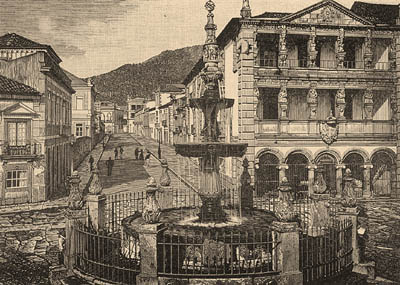
The great abundance of granite quarried in the surroundings allows the streets to be paved with "indestructible" stones, "giving the pavement a surface as smooth as a stone wall." There are no trams, no noisy taverns, no posters on corners, no barrel organs, no garbage, no flies, no visible police. The Republic Square—built by King Manuel for public festivities—preserves "a beautiful Renaissance air" with its sixteenth-century fountain and the historic façade of the Misericórdia Palace, a Renaissance masterpiece by architect João Lopes with its caryatids and tiles by Policarpo de Oliveira Bernardes. Through the narrow and winding streets of the old town, "beautiful door and window arches" in the "interesting half-Gothic half-Moorish style" that characterizes Manueline architecture. In the convents of Santa Cruz (where Archbishop Frei Bartolomeu dos Mártires lived and died) and São Domingos (which he built), "the ancient flow of water that so sweetly lulled monastic retreat dried up and fell silent," and "the echo of the community's sandals at the canonical hours of prayer was lost." But the port had lost "all the importance of ancient times with the general decline of our maritime commerce": of the movement of caravels of the famous corsair Pero Galego and the seafarer João Álvares Fagundes—discoverer of the Newfoundland banks for cod fishing—of the extensive maritime trade of the fifteenth and sixteenth centuries when "the nobility of Viana, making an exception to the rest of the Country, imitated Venetian and Genoese merchants in the exercise of commerce," nothing remained "but some archaeological vestiges of the ancient seafarers' confraternity."
Ramalho's account of Viana articulates two apparently contradictory registers: aesthetic celebration and fatal economic diagnosis. On one hand, he praises the serene beauty, the rigorous cleanliness, the "vague perfume of art" in the austere solitudes of the convents, the public garden by the wharf ("certainly the best situated in the Country"), the "interesting" Manueline style that testifies to past glories. On the other, he decrees without appeal: "presently reduced to its small domestic commerce, Viana is a dead city for mercantile labor." This sentence reveals Ramalho's economic thinking: port cities without active maritime commerce have no productive future. But the chronicler, in a characteristic dialectical movement, transforms the funerary diagnosis into a tourist prescription: "hence, from the aesthetic side, a good part of its charm as a land of leisure and pleasure." And then comes the visionary proposal: "a bathing establishment, a casino, a grand hotel and some furnished cottages for rent, on the beach, on the left bank of the river, and this would certainly be one of the most beautiful seaside resorts in all of Europe." Ramalho intuits Viana's tourist potential—the Lima river, proximity to the sea, Renaissance architecture, mild climate, landscape between the green valley and the Santa Luzia mountains—and imagines transforming the mercantile "dead city" into a European seaside resort. The proposal would not materialize in the terms Ramalho envisioned, but anticipates by decades the tourist development of the twentieth century.
Today, visitors to Viana do Castelo find a city that balances memory and modernization. Republic Square remains intact—the sixteenth-century Fountain with the armillary sphere, the medieval Town Hall, the Renaissance Misericórdia House with its twenty-one caryatids. The Santa Luzia Sanctuary, built in 1926 according to Ventura Terra's design, partially fulfilled Ramalho's dream of making Viana a tourist destination, albeit through religious pilgrimage rather than spa bathing. The Eiffel Bridge (inaugurated in 1878, a few years after Ramalho's visit) continues to provide passage over the Lima. The convents where the monastic water "dried up and fell silent" preserve that "vague perfume of art" that the chronicler sensed. Observing with "Ramalho's eyes," one can reflect on how the city managed to transform commercial "death" into cultural and tourist vocation without losing the "modesty, simplicity, silence and cleanliness" that so impressed the nineteenth-century visitor. Viana did not become Wiesbaden or Trouville, but remained authentically Vianense—between sea and river, between the memory of the seafarers who discovered the Atlantic and contemporary visitors who discover, even today, that "beautiful Renaissance air" that time has not been able to completely erase.